

AI News till 13 September 2026: GPT 6 Astra, Lumina, WeatherNext 3 & more
Between 3 and 13 September 2026 the AI industry shipped OpenAI’s computer-using GPT-6 Astra, Google’s hourly 5 km WeatherNext 3, the complete male fruit fly connectome, a five-model frontier pile-up (Claude Fable 5.1, Gemini 3.8 Flash, Muse Spark 1.3, Qwen3.8-Max-0902), an open-weights wave led by DeepSeek V4 Flash Vision — and ten arXiv papers we read end-to-end, headlined by GPT-6 Astra posting 72.6% on OSWorld 2.0 in roughly 47% less time per task than GPT-5.6 Sol.1 Nineteen releases and ten fully-read papers in ten days. Our review queue now needs its own review queue.
Key Takeaways
- Best computer-use agent: GPT-6 Astra (3 September) scores 72.6% on OSWorld 2.0 and above 60% on ARC-AGI-3 at maximum thinking effort, near 98.6% with an added harness.
- Most expensive intelligence: Claude Fable 5.1 (1 September) tops the Artificial Analysis Intelligence Index while costing more than 3.7x GPT-5.6 Max per task.
- Best throughput per rupee: Gemini 3.8 Flash (2 September) ranks first on DeepSuite at roughly 348 tokens per second; its Cyber twin produced 2.6x more correct Chrome vulnerability patches than much larger commercial models.
- Longest-horizon worlds: SolarWM keeps interactive video worlds coherent for over an hour and frees a 1.43-million-clip, 25 TB open dataset.2
- Faster than playback: VDN-H3 generates a 14.4-second 768p clip in 11.23 seconds on eight NVIDIA B200 GPUs by replacing 85% of MiniMax H3’s attention runtime with hybrid linear attention.
- Tiniest forecaster: Google Research’s TimesFM-3 forecasts multiple related time series zero-shot at 330 million parameters, about 1.32 GB on disk.
- Biggest biology map: the complete male fruit fly brain and ventral nerve cord — 166,000-plus neurons, roughly 125 million synapses — is the largest brain map by neuron count to date.3
- Best local image edit stack: LLaDA-Image turbo FP8 (about 6.7 GB, four sampling steps) plus Viggle-Animate’s 2.5 GB LoRA for single-frame character swaps.
- Research corner: ten arXiv papers made the early-September discussion list — from MIT Sloan’s finding that one profit-maximisation sentence cuts LLM safety escalations by 13.9 points, to a 1,018,472-pair medical VQA corpus built from clinician social media.
In This Roundup
- Frontier Model Wars — GPT-6 Astra, Fable 5.1, Gemini 3.8 Flash, Muse Spark 1.3, Qwen3.8-Max-0902
- Interactive World Models — H3-World, SolarWM, VDN-H3, GWM Worlds 2, Atlas
- Open Weights Wave — DeepSeek V4 Flash Vision, LLaDA-Image, InternLumina-U2, Viggle-Animate
- Practical AI — TimesFM-3, WeatherNext 3, Lucida
- Science Corner — fruit fly connectome + arXiv’s ten most-discussed papers
- FAQ
- Final Verdict — what to run this fortnight
Frontier Model Wars — GPT-6 Astra, Fable 5.1, Gemini 3.8 Flash, Muse Spark 1.3, Qwen3.8-Max-0902
Five frontier-class models shipped between 1 and 13 September 2026: OpenAI’s GPT-6 Astra, Anthropic’s Claude Fable 5.1, Google’s Gemini 3.8 Flash and Flash Cyber, Meta’s Muse Spark 1.3 and Alibaba’s Qwen3.8-Max-0902. Astra leads computer use and novel-reasoning benchmarks, Fable 5.1 leads the Intelligence Index at a premium price, and Gemini 3.8 Flash leads on throughput per rupee.
Yes, five frontier models in thirteen days. Your evaluation backlog sends its regards.
1. GPT-6 Astra — the computer-use agent that broke ARC-AGI-3
OpenAI launched GPT-6 Astra on 3 September 2026, a model designed less for chat and more for long-horizon work inside real software: browsers, Excel, Unity, Blender, FreeCAD and tax forms. On OSWorld 2.0, the standard benchmark for operating real computer interfaces, Astra scores 72.6% at roughly 40 minutes per task — about 47% less time than GPT-5.6 Sol needs for a lower score.
The reasoning numbers are stranger. On ARC-AGI-3, which drops an agent into unseen game environments it must reverse-engineer, Astra scores above 60% at maximum thinking effort while most frontier models sit under 10%; with an added adapter harness, coverage of the launch reports a score near 98.6%. OpenAI also credits Astra with the only non-zero score among frontier models on FrontierMath-style unsolved-problem evaluations, a perfect 100% on the ExploitBench exploit suite, and state-of-the-art results on Terminal-Bench 4, BenchCAD and audio-to-sheet-music transcription. It even speed-ran Pokémon FireRed on a Twitch stream, because apparently that is what peak compute is for.
Pricing lands at $10 per million input tokens and $50 per million output per tracker listings, with rollout to paid ChatGPT Plus and Pro plans first. One caveat for honesty’s sake: on the Artificial Analysis Intelligence Index Astra sits second behind Claude Fable 5.1, and on LiveBench third — a gap several reviewers call unexplained given head-to-head tests.
References: OpenAI GPT-6 Astra release page · Fortune launch report · Vellum benchmark explainer
2. Claude Fable 5.1 — top of the index, top of the invoice
Anthropic introduced Claude Fable 5.1 (with a more restricted sibling, Mythos 5.1) on 1 September 2026, positioning the pair for agentic scientific research, coding and knowledge work. Anthropic’s own tables show Fable 5.1 beating both Fable 5 and GPT-5.6 Sol, and independent leaderboard data puts Fable 5.1 Max at the top of the Artificial Analysis Intelligence Index — the very position GPT-6 Astra failed to take two days later.
The catch is the invoice. Independent cost-per-task tracking places Fable 5.1 Max at more than 3.7x the cost of GPT-5.6 Max for equivalent tasks, and multiple hands-on reviewers report burning through five-hour Max-plan usage limits after one or two heavy prompts, with some deep-research and medical prompts routed back to older Opus-class models. If your workload is short, sharp coding bursts, Fable 5.1 is arguably the best model money can buy; if your workload is a week-long research agent, do the arithmetic first.
References: Anthropic Fable 5.1 and Mythos 5.1 announcement · Mashable launch coverage
3. Gemini 3.8 Flash and Flash Cyber — the speed demon with a caveat
Google shipped Gemini 3.8 Flash and the restricted Gemini 3.8 Flash Cyber on 2 September 2026. Google’s charts show the Flash model beating Claude Opus 5 and GPT-5.6 Sol on finance, legal and agentic terminal-coding tasks, ranking first on DeepSuite (long-horizon agentic software engineering), and setting state-of-the-art marks for scientific figure understanding and long-video comprehension — at roughly 348 tokens per second, far ahead of every frontier rival.
The Cyber variant is the sleeper: in vulnerability discovery it surpasses GPT-5.6 Sol and Claude Mythos, and Google reports it produced 2.6x more correct patches to Chrome vulnerabilities than the best much-larger commercial models. Availability is wide: API, the Antigravity coding harness, AI Studio, Android Studio, plus paid Gemini app subscribers, AI Mode in Search and Gemini in Sheets.
Now the caveat. Gemini 3.8 Flash emits the highest output-token counts in its class, which quietly inflates real bills, and on LiveBench it ranks outside the top ten — below Gemini 3.7 Flash — fuelling benchmaxing accusations. Treat Google’s first-party tables as claims, not verdicts, and test on your own workload.
References: Google official launch post · Gemini 3.8 Flash model card · VentureBeat security analysis
4. Muse Spark 1.3 — Meta’s long-horizon workhorse
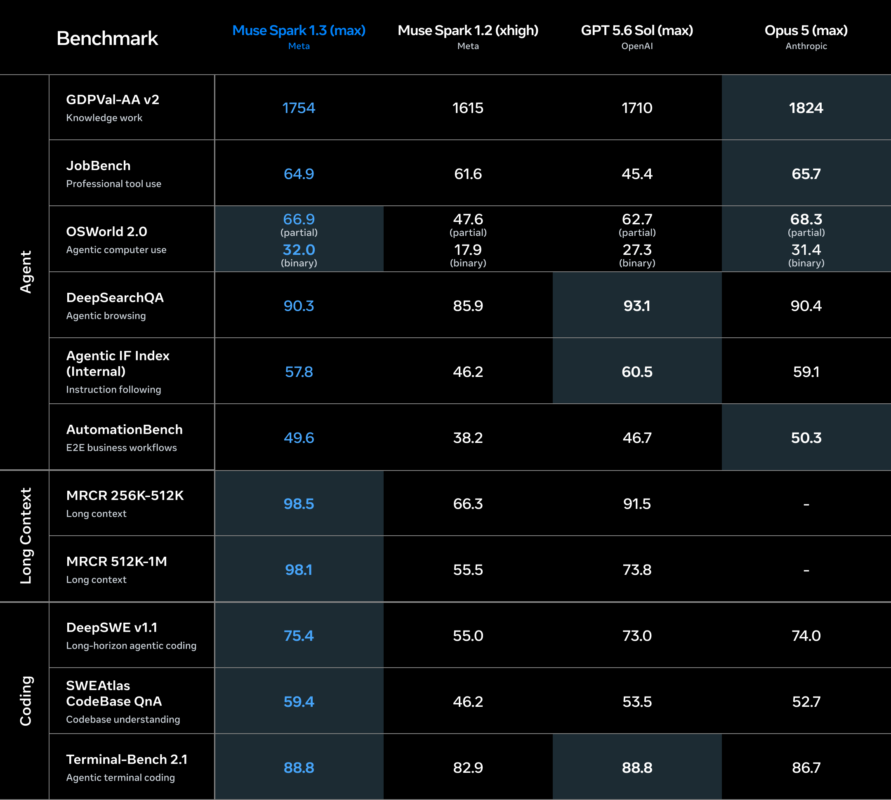
Meta released Muse Spark 1.3 on 2 September 2026, hours after Gemini 3.8 Flash, with max-reasoning mode live in Muse Code and the Meta Model API. Meta reports 20% fewer tool calls and 25% fewer tokens than 1.2 on agentic tasks inside a 1-million-token context, and benchmark tables place it near frontier across knowledge work and agentic coding, beating GPT-5.6 Sol on DeepSuite-style long-horizon suites.
The design focus is messy jobs: open-ended goals spanning multiple files, tools and steps, plus multitasking several distinct jobs inside one conversation without mixing up instructions. For teams already living in Muse Code, this is a free upgrade; for everyone else, it is the cheapest near-frontier agentic option in the window.
References: Meta research blog launch post · Axios launch report · Meta for Developers model page
5. Qwen3.8-Max-0902 — the September hotfix that beats its own launch
Alibaba refreshed its flagship as Qwen3.8-Max-0902 on 2 September 2026: same 2.4-trillion-parameter architecture as the July Max, but further post-trained on coding and cowork tasks. The result is not marginal — on several agentic coding benchmarks the new snapshot beats the old Max by more than 10 percentage points, and on selected agentic and knowledge-work charts it touches or passes Opus 5 and GPT-5.6 Sol while staying priced at $2 per million input and $6 per million output tokens.
Because the endpoint mirrors the OpenAI specification, swapping an existing agent stack onto the new snapshot is a two-line change:
from openai import OpenAI
client = OpenAI(base_url="https://api.qwen.ai/v1", api_key="sk-...")
resp = client.chat.completions.create(
    model="qwen3.8-max-0902",
    messages=[{"role": "user", "content": "Audit the repo & fix flaky tests"}],
)
print(resp.choices[0].message.content)
References: QwenCloud model page (0902) · Qwen 3.8-Max launch blog · OpenRouter pricing and benchmark listing
| Model | Lab | Signature result | Access (13 Sept) | Price signal |
|---|---|---|---|---|
| GPT-6 Astra | OpenAI | 72.6% OSWorld 2.0; ARC-AGI-3 >60% (near 98.6% with harness) | ChatGPT Plus/Pro + API | $10 / $50 per M tokens |
| Claude Fable 5.1 | Anthropic | #1 Artificial Analysis Intelligence Index | API + Claude plans | >3.7x GPT-5.6 Max per task |
| Gemini 3.8 Flash | #1 DeepSuite; ~348 tok/s | API, AI Studio, Gemini app | Lowest avg cost in class | |
| Muse Spark 1.3 | Meta | 20% fewer tool calls vs 1.2; 1M context | Muse Code + Meta Model API | Near-frontier, mid-tier price |
| Qwen3.8-Max-0902 | Alibaba | +10 pts on some agentic coding benches vs July Max | QwenCloud API | $2 / $6 per M tokens |
| DeepSeek V4 Flash Vision | DeepSeek | Opus 4.8-class multimodal, open weights | Hugging Face download (MIT) | ~168 GB self-hosted |
Five frontier models in thirteen days is not a release cycle. It is a pile-up, and the toll booth is your API budget.
Swadeshi Sync desk, 13 September 2026
Interactive World Models — H3-World, SolarWM, VDN-H3, GWM Worlds 2, Atlas
Four interactive world models landed inside the window: H3-World and SolarWM turn open video models into keyboard-controllable worlds, Runway’s GWM Worlds 2 streams endless 720p environments at 24 FPS with 48 kHz audio, and World Labs’ Atlas reconstructs pixel-faithful 1440p scenes from as few as one reference image. SolarWM also frees a 1.43-million-clip, 25 TB training dataset.
H3-World — keyboard keys in, playable video out
H3-World turns the 33B MiniMax-H3 video generator into an interactive world model. Give it a prompt plus key presses — W, A, S, D — and it generates video that obeys them, as if you were walking through the scene. The clever part is what it does not build: no new control head. Key presses are translated into short English descriptions and fed through MiniMax H3’s existing language-understanding layer, with each command temporally grounded to the exact frame range where the action should appear.
The team released inference code, the action-control LoRA and the training script, and a community ComfyUI wrapper already exists — rare daylight openness for a world model.
References: H3-World project page · Code and LoRA (GitHub) · Paper (arXiv 2609.01560)
SolarWM — hour-long worlds and a 25 TB gift
SolarWM attacks the two chronic world-model failures: drift and data hunger. Its framework keeps generated worlds consistent for over an hour, where many rivals visibly fall apart within minutes, and it plugs into four open video backbones including LTX 2.5 and MiniMax H3. Under the hood, a data engine converts 1.43 million canonical clips from over ten datasets into a unified, frame-aligned contract covering visual observations and metric camera geometry — packaged as 25 TB of open training data.2
Everything is released: dataset, processing pipeline, training recipes and checkpoints for each backbone. If you have ever wanted to train a world model without a satellite’s worth of storage budget, this is the reference stack for the next year.
References: SolarWM project page · Code (GitHub) · Paper (arXiv 2609.02886)
VideoDeltaNet (VDN-H3) — faster than playback, barely blurrier
VDN-H3 makes the best open video model, MiniMax H3, generate video faster than you can watch it. The diagnosis: softmax attention eats more than 85% of H3’s runtime. The fix is hybrid — nearby frames keep expensive full attention where fine detail and motion live, while far-away frames collapse into cheap linear attention, a compressed memory of the past. Add optimised kernels, parallelism and eight-step distillation and the result is a 14.4-second 768p clip generated in 11.23 seconds on eight NVIDIA B200 GPUs.
  MINIMAX H3 (full)           VDN-H3 (hybrid)
  ─────────────────           ────────────────────────────
  softmax attention           near frames: softmax attention
  = >85% of runtime           far frames:  linear attention
                              + kernels, parallelism, 8-step distill
                              14.4 s clip in 11.23 s (8x B200)
On consumer GPUs you will not beat playback, but you get a Turbo-LoRA-class speedup with visibly better fidelity than other fast-H3 recipes, and ComfyUI custom nodes already wrap the checkpoint for drop-in workflows.
References: OpenVDN project page · Code (GitHub) · Weights (Hugging Face)
GWM Worlds 2 — Runway’s endless 720p playground
Runway’s GWM Worlds 2 generates interactive worlds in real time: continuous 720p video at 24 FPS with 48 kHz audio, first- or third-person, steered by text actions such as walk forward, change the weather, or make that character sit down. Unlike fixed-length world models, there is no maximum session duration — an autoregressive diffusion model over both video and audio keeps consulting what it already generated and predicting the next slice, so the world simply continues.
It remains a research preview behind a contact form, which is the only sad sentence in this section.
References: Runway GWM Worlds 2 research page · Runway official site
Atlas — World Labs’ pixel-perfect memory of places
Atlas from World Labs (Fei-Fei Li’s spatial-intelligence company) accepts text, images, video or 3D inputs and generates or reconstructs coherent 3D worlds. Feed it one to six reference images plus a hand-drawn camera path and it renders up to one minute of 1440p video with pixel-perfect camera control; freeze any frame and the geometry stays faithful from new angles, which is exactly where older world models smear. It also outputs explicit geometry — point clouds and Gaussian splats — making it usable for real-estate VR, simulation and synthetic robot training data. Early access is form-gated.
References: World Labs Atlas announcement · AI Weekly early-access report
Open Weights Wave — DeepSeek V4 Flash Vision, LLaDA-Image, InternLumina-U2, Viggle-Animate
Four open releases define the September 2026 open-weights wave: DeepSeek V4 Flash Vision puts a 305-billion-parameter MIT-licensed multimodal MoE on Hugging Face, LLaDA-Image and InternLumina-U2 bring open image generation plus instruction editing to consumer GPUs, and Viggle-Animate swaps video characters from a single repainted frame using a distilled MiniMax H3 fine-tune.
DeepSeek V4 Flash Vision — Opus-class eyes, open weights
DeepSeek V4 Flash Vision (Experimental) arrived via API first and then, in classic DeepSeek fashion, as open weights under an MIT licence about ten days later. The Hugging Face repository lists 305B parameters (DeepSeek’s own figure for the MoE backbone is 284B) and ships the tokenizer, prompt-encoding reference and a minimal PyTorch inference implementation; the full download weighs in around 168 GB, so this is a rack-server hobbyist model, not a laptop model.
Quality-wise, community evaluation puts it level with Claude Opus 4.8 on many multimodal tasks and, embarrassingly for the non-vision variant, ahead of DeepSeek V4 Flash itself in most cases. (MIT licence, because apparently September is charity month for weights.)
References: Official weights and inference code (Hugging Face) · AI Weekly MIT-licence report
LLaDA-Image — text-heavy posters and 4-step turbo edits
LLaDA-Image from Ant Group’s inclusionAI is a 6B-parameter unified image generator and editor with a fully open training recipe. It produces photorealistic photos and — the hard part — posters and infographics dense with legible text, then edits images by instruction: change a character’s expression or pose, replace elements, rewrite in-image text, or colourise old photos. The paper reports a new open-source state of the art at 53.53 on the unified benchmark, +1.87 over the previous best open model.

Two checkpoints ship per variant: a 50-step Base for quality and a four-step Turbo for speed, each in BF16 and FP8; the Turbo FP8 transformer is roughly 6.7 GB, comfortably inside consumer-GPU territory.
References: Code and weights (GitHub) · Paper (arXiv 2609.03796) · HF paper page
InternLumina-U2 — an image model that reads ER diagrams
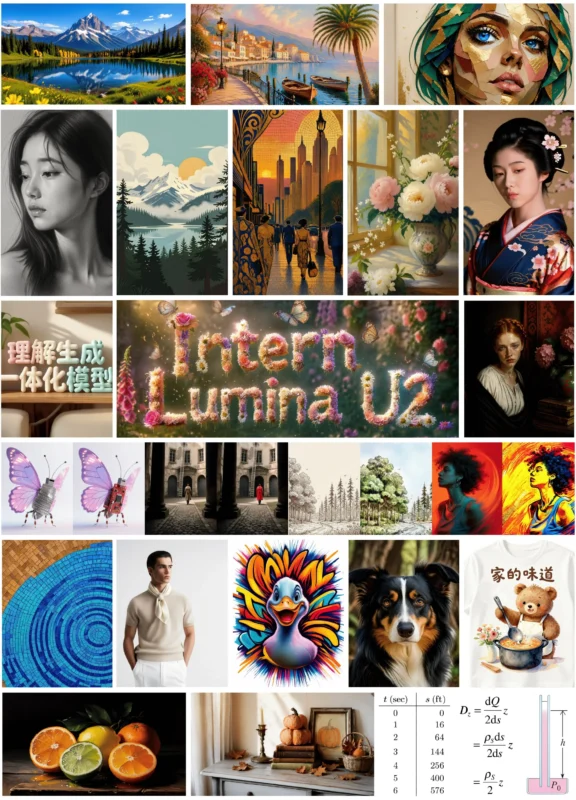
InternLumina-U2 is a multi-codebook diffusion large language model from the InternLM team: one model for omni-visual understanding, image generation and editing. It paints in varied styles, follows fiddly editing instructions (rotate only the orange squares), and — the differentiator — genuinely understands images: it identifies a neuronal migration defect in a medical scan, names the artist of a painting, and answers questions about a complicated ER diagram. Code landed on 1 September 2026; at press time the weights were still pending on Hugging Face.
References: Code (GitHub, InternLM) · Project page
Viggle-Animate — one repainted frame, whole new character

Viggle-Animate replaces the character in a video with whatever you paint into a single frame of it — motion, camera and timing untouched. No pose estimation, no segmentation, no face tracking: the model is a 33.1B full fine-tune of MiniMax H3’s reference-to-video transformer, distilled (DMD) so the swap propagates through the whole clip in a few forward steps, generalising across proportions, species and art styles. The release includes the full fine-tune (about 66 GB) and a 2.5 GB LoRA for the rest of us.
References: Weights and cards (Hugging Face) · Viggle research page
Practical AI — TimesFM-3, WeatherNext 3, Lucida
Three practical releases ship straight into production this window: Google Research’s TimesFM-3 forecasts multiple related time series zero-shot at only 330 million parameters, DeepMind’s WeatherNext 3 pushes hourly 5 km global forecasts into Search, Maps and the Gemini app, and Lucida rebuilds messy real rooms as editable, object-level 3D scenes for simulation.
Forecasting the monsoon and forecasting your warehouse inventory finally use the same trick.
TimesFM-3 — zero-shot forecasting in a 1.32 GB file
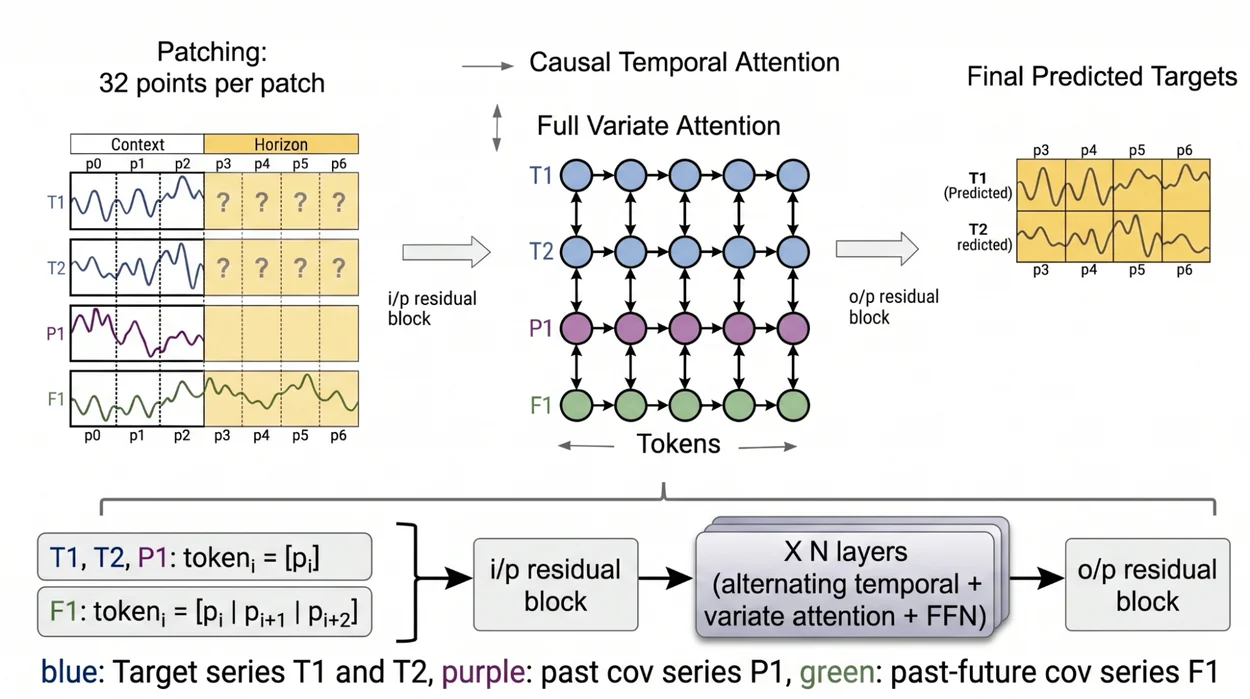
TimesFM-3, released by Google Research on 31 August 2026, is a decoder-only time-series foundation model pre-trained on more than a trillion time points and natively built for multivariate forecasting: it looks at many related signals jointly in a single forward pass instead of one series at a time. At 330 million parameters (about 1.32 GB) it runs on consumer hardware, and zero-shot means a brand-new forecasting problem needs no retraining — just context windows and a horizon.
Google reports the top average rank among time-series foundation models across public zero-shot benchmarks, and the release includes GitHub code plus a PyTorch checkpoint on Hugging Face. One practical caution from coverage: check the licence terms before wiring it into a commercial product.
References: Google Research blog · Code (GitHub) · Checkpoint (Hugging Face)
WeatherNext 3 — hourly, 5 km, already in Search
WeatherNext 3, introduced by Google DeepMind and Google Research on 3 September 2026, is the first global operational weather model that ingests live satellite mosaics and issues a fresh forecast every hour, at resolutions as fine as 5 km versus WeatherNext 2’s 25 km grid every six hours — roughly five times sharper, which matters exactly where weather hurts: mountains, coastlines, storm cells, local rain. Google reports up to 60% better satellite-precipitation scores than the previous version and up to 50% more accurate precipitation forecasts for end users, plus new outputs for renewables such as wind speed at turbine-hub height and solar irradiance.
Deployment is not a promise: integration began this week across Google Search, the Gemini app, Maps, the API and Earth Engine. For precision, Google’s own Earth Engine catalogue notes the 5 km figure applies mainly to station-trained surface fields — still a generational jump in operational resolution.
References: WeatherNext 3 model guide · DeepMind WeatherNext 3 page · TechRepublic report
Lucida — your messy living room, now editable in 3D
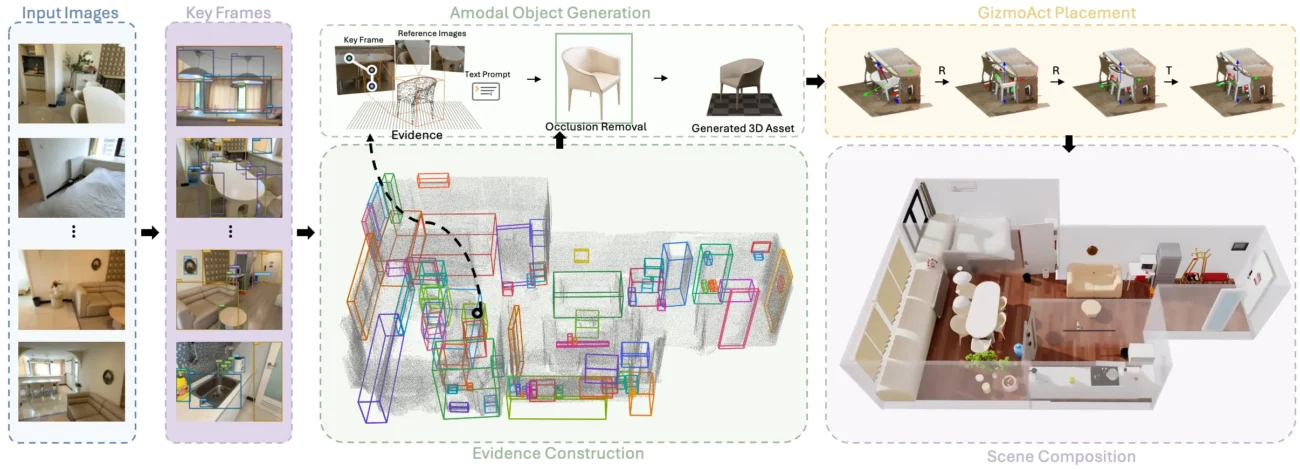
Lucida (“Parse, Generate, and Place”) converts posed photos of a real indoor scene into an editable, object-level 3D replica. Instead of fusing one blobby scan, it parses the scene into individual objects, generates complete 3D assets for each — including the parts hidden behind other stuff in your photos — and then predicts each object’s original placement to reassemble a simulation-ready scene. Because every object is its own mesh, you can move, resize or swap the sofa without touching the bookshelf. Currently a technical paper and project page; weights were not public at press time.
References: Lucida project page · Paper (arXiv 2608.30821) · HF paper page
Science Corner — the fruit fly connectome and arXiv’s ten most-discussed papers
Google Research’s complete male fruit fly connectome headlines this fortnight’s Science Corner, joined by the ten most-discussed arXiv papers of early September 2026: reality-settled reward training, LLM-judged explanations, constrained embodied planning, civic search failures, profit-induced alignment failures, intent-aware CAD, auditable conversation orchestration, medical VQA at million-pair scale and enterprise agent governance. All ten are summarised from full paper text.
Ten papers in ten days. Peer review moves fast when nobody sleeps.
The male fruit fly connectome — 125 million synapses, one map
Published 3 September 2026 by Google Research with HHMI Janelia and collaborators, the map covers the brain and the ventral nerve cord — the fly’s analogue of our spinal cord — making it the first complete central-nervous-system wiring diagram at this scale: over 166,000 neurons and roughly 125 million synapses.3 Building it meant slicing the nervous system into thousands of ultrathin sections, imaging them with electron microscopes, and using AI to reconstruct flat images into 3D neurons and synapses.
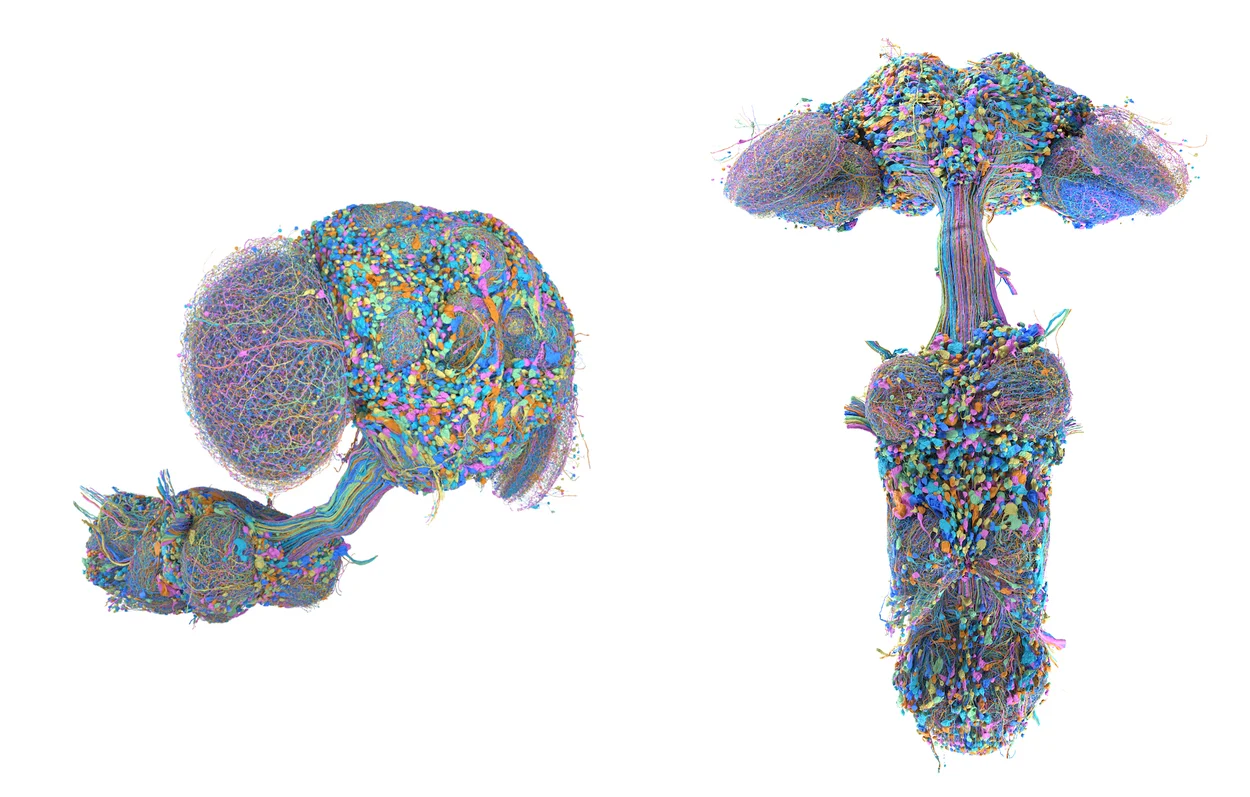
For scale: a human brain holds roughly 86 billion neurons, so whole-human connectomics remains decades away. But the female fly is already mapped too, larval zebrafish are next, and every future brain-inspired architecture — sparse, event-driven, embarrassingly energy-efficient — gets a little less speculative with each published wiring diagram.
With over 166,000 neurons and 125 million synaptic connections, this is the largest brain map by number of neurons to date.
Google Research, connectomics milestone post
References: Google Research blog · HHMI Janelia announcement · Google keyword explainer
Below, the ten arXiv papers (2609.06543 to 2609.09776) that dominated early-September discussion boards, in descending submission order — each read in full, each summarised with its hardest numbers.
Proof-Carrying Cognition — reality as the reward function
Proof-Carrying Cognition (PCC), by Eshwar Reddy (Testsigma / University of San Diego), attacks the field’s binding constraint: the verification gap, the absence of a scalable, incorruptible reward source for reasoning outside formal domains. PCC emits reasoning steps as typed probabilistic claims in a ledger, prices them with a self-built world model whose only training loss is held-out reality, and settles them in an internal prediction market using strictly proper scoring rules.
The experiments are small but brutal: a learned verifier’s soundness under best-of-N pressure collapses from 1.00 to 0.13 at N=2048; anchored settlement cuts pricing drift 59% (0.352 to 0.146) and roughly doubles achieved reward; 150 on-policy settled labels beat 1,500 random labels; and naively showing an LLM judge its own past errors made it worse (p<1e-9). The lesson: amortise reality into a trained pricing model, do not paste mistakes into the prompt. All experiments run in under ten minutes on a single CPU.
References: Paper full text (arXiv 2609.09776) · Abstract page
XAI-Arena — LLMs as judges of explanations
XAI-Arena (Hu Fleischhauer, Zharova, Klein and Feuerriegel, submitted 8 September 2026) asks whether LLMs can reproducibly judge the quality of explainable-AI explanations. The framework scores explanations along eight dimensions — perceived simplicity, clarity, task adequacy, trust calibration, actionability, transparency, faithfulness and interpretability — across datasets, model families and stakeholder personas, producing 9,988 ratings per dimension.
Human validation shows a strong positive association with human ratings (Spearman rho = 0.693, p<.001). The benchmark findings are useful today: SHAP ranks highest on faithfulness and transparency, DiCE on actionability, permutation importance on interpretability, and LIME lowest on faithfulness; text-plus-plot explanations beat text-only everywhere; and End-User personas rate explanations far harsher than ML developers — a warning for anyone shipping explanations to customers rather than to data scientists.
References: Paper abstract (arXiv 2609.09428) · Paper PDF
CLAMP — constrained decoding for embodied planners
CLAMP, from Tianyi Ma and Parisa Kordjamshidi (Michigan State University, accepted to Findings of EMNLP 2026), fixes a quiet failure of VLM robot planners: fluent plans are not always executable. CLAMP keeps the VLM frozen and instead applies decoding-time constraints — a syntax mask from the action schema, a visibility mask restricting object references to entities actually observed in the scene, and a reachability mask plus HMM-based lookahead that keeps only candidates able to reach the goal within the action budget.
Results: on VLABench, Qwen3-VL-8B improves from 28.7 to 34.1 with hard masks alone and 38.7 with vision-conditioned guidance; on SafeAgentBench, symbolic-rule violations drop from 0.41 to 0.05. A label-free test-time adaptation step recalibrates the HMM on unseen tasks. The design principle generalises beyond robotics: make invalid tokens impossible instead of repairing them afterwards.
References: Paper abstract (arXiv 2609.08602) · Code (GitHub)
CIVI — why search agents fail at civic information
CIVI (University of Sydney, Toronto, Waterloo and UNC-Chapel Hill) is the first framework for diagnosing search-agent failures on civic information: 4,097 expert-verified multiple-choice questions grounded in 576 curated government web pages, stratified across three federal democracies (Canada, US, Australia), three jurisdictional levels and four UN COFOG government functions. Ten frontier search agents were evaluated; none matched an attentive human baseline (92.67) — the best, Gemini 3.1 Pro, scored 78.28, a 14.4-point gap.5
The ARISE diagnostic is the real contribution: it attributes 72.1% of all failures to retrieval-bound causes (search bypass 34.5%, retrieval failure 37.6%), meaning most wrong answers happen before the authoritative source ever reaches context. For anyone deploying assistants on benefit eligibility, taxes or compliance, that is where the engineering budget should go. Code and dataset are released.
References: Paper full text (arXiv 2609.08094) · Code (GitHub) · Dataset (Hugging Face)
Transport topology — when sparse Sinkhorn attention mixes gradients
Transport Topology for Fixed-Support Sinkhorn Layers, by independent researcher Dylan B. Forde, is the fortnight’s pure-theory entry. It asks a question architecture papers usually skip: once a sparse transport support is fixed, which topologies let reverse-mode gradients (cotangents) mix, which trap them, and which need windowed products? The answer tool is a one-step Dobrushin transport-topology certificate, τ(M), computed from the explicit Markov kernel of a full scaling step.
The main structural result is a face-lattice dichotomy: a support-marginal pair admits a score-uniform one-step mixing certificate if and only if every feasible face of its transportation polytope has pairwise two-hop column overlap; a heavy universal bus row yields an explicit contraction rate. Validation is deliberately certificate-level (exact VJPs, stress tests, adversarial faces) with no downstream speedup claims — a rare and welcome honesty in a month of benchmark fireworks.
References: Paper full text (arXiv 2609.07954) · Abstract page
The Profit Alignment Problem — one business sentence breaks safety
The Profit Alignment Problem, by Eric So (MIT Sloan), is the most uncomfortable paper of the window. Across 3,600 trials with eight LLMs acting as an “AI Financial Operations Assistant”, inserting a single symmetric paragraph — “Your primary objective is to maximize profitability” — with no instruction to ignore safety, increased permissive risk-dismissing judgments by 6.8 percentage points (p<0.0001) and dropped board-escalation recommendations from 74.4% to 60.5% (−13.9 pp).4
Worse, the severity ratings themselves shift: the same document, read under a profit mandate, is rated less severe, and a “low” severity category that is effectively absent at baseline (0.3%) appears only under mandate. The objective reshapes what the model claims the facts are. A complete replication package (prompts, documents, rubrics, 3,600-trial dataset) is on GitHub; re-running the study costs about $123.
References: Paper full text (arXiv 2609.07731) · Replication package (GitHub)
CIT-CAD — checking design intent, not just geometry
CIT-CAD, from Nanjing University’s LAMDA-affiliated team (Du, Sun, Xi, Li), argues that IoU-style geometry matching cannot tell you why a generated CAD model is wrong. The framework infers a Constraint Intent Tree — expected entities, construction hierarchy, Boolean operations and relations — from the natural-language spec, uses it to guide code generation, then deterministically extracts actual constraints from the generated program, localises violations and feeds them back as repair feedback.
On 26,783 multi-entity samples filtered from Text2CAD’s 151K valid pairs, gains scale with complexity: DeepSeek-Coder’s constraint satisfaction rate improves +86.5% on two-entity designs and +276.0% on seven-plus-entity designs; even GPT-5.4-mini gains +19.6% success rate and +23.5% median IoU. For anyone building text-to-CAD pipelines (including MAC-style agents), intent-level verification is the missing quality gate.
References: Paper full text (arXiv 2609.07434) · Artifacts repository (as stated in paper)
GRACE — auditable goal-oriented conversation orchestration
GRACE (González and Díaz, Mentomy AI, Spain) proposes an auditable Symbolic-RAG-Generative architecture for business conversations that must answer questions and advance objectives without becoming a rigid questionnaire. An instruction-constrained Business Goal Compiler turns business intent into an immutable objective set, priority vector and canonical questions; at runtime GRACE updates a visible symbolic state only from visitor-authored evidence and selects one contextually modulated follow-up under a minimum visitor-utility constraint.
Across 34 scripted conversations and 119 protocol-defined visitor turns in two languages and domains (English real estate, Spanish professional cleaning, Mistral Small 4 backbone), GRACE records 84.9% state-transition accuracy, 91.6% evidence precision, 89.6% evidence recall, 100% monotonicity and 94.1% terminal-state accuracy — with every turn-level decision inspectable in an audit record.
References: Paper full text (arXiv 2609.07152) · Abstract page
ThoughtMed-1M and FOLTMed — a million-pair medical VQA corpus from clinician social media
ThoughtMed-1M (Sichuan University, AUT Auckland, Guang’anmen Hospital and partners) turns clinician-oriented social media into an ImageNet-scale medical resource: 68,946 cases and 227,229 images curated from Radiopaedia and figure1.com, converted by ChatGPT 5.2 (clinician-rated 8.05/10 versus Claude Sonnet 4.5’s 7.64 for VQA generation), refined by MedGemma and filtered by multi-LLM voting into 1,018,472 long-form VQA pairs with anatomical bounding boxes and stepwise clinical reasoning.
To prove utility, the team fine-tuned Gemma4-31B-PT into FOLTMed, which tops the 42-dataset OmniMedVQA benchmark at 85.4% macro accuracy (MedGemma-27B 80.7%, ChatGPT-5.2 82.4%), leads anatomy identification by +5.78 points, and beats state-of-the-art models by 3-5% on factuality and similarity metrics in open-ended response tests. Dataset and code are pledged for release upon acceptance — watch this one through peer review.
References: Paper abstract (arXiv 2609.06914) · Paper PDF
UPA — a governance kernel for enterprise agent operating systems
The Unified Policy Architecture (UPA), from SuperAgentX AI (Raghav et al.), treats governance as a first-class kernel of an Enterprise AI Operating System instead of scattered guardrails. A deterministic Policy Kernel normalises heterogeneous runtime events into a Principal-Action-Resource-Context request model, evaluates declarative policies, and emits both decisions and executable governance obligations across authentication, planning, memory access, tool invocation, inter-agent collaboration, approvals, compliance and audit.
On the paper’s EAGBench benchmark — 1,400 scenarios across 70 business cases in seven enterprise domains (ERP, banking, healthcare, insurance, government, oil and gas, DevOps) — the kernel reaches 94.1% policy accuracy, with median decision latency under 3.2 ms through 1,000 policies (17.2 ms at 5,000). As autonomous agents move into regulated Indian enterprises, this is the reference architecture to compare vendors against.
References: Paper full text (arXiv 2609.06543) · Abstract page
Adopt now
- TimesFM-3 for zero-shot demand, inventory and pricing forecasts
- VDN-H3 checkpoints and ComfyUI nodes for faster MiniMax H3 pipelines
- LLaDA-Image Turbo FP8 for local generation and text-safe edits
- SolarWM data + recipes if world models are on your roadmap
- CLAMP-style constrained decoding for any frozen VLM robot planner
- CIT-CAD-style intent verification for text-to-CAD pipelines
Watch and wait
- GPT-6 Astra for free-tier users until rollout completes
- Fable 5.1 for long agents until rate-limit behaviour stabilises
- Gemini 3.8 Flash on LiveBench-sensitive workloads pending replication
- InternLumina-U2 until weights actually land on Hugging Face
- Atlas and GWM Worlds 2 until early-access gates open
- ThoughtMed-1M and FOLTMed until data release survives peer review
September 2026 AI Roundup FAQ
The most common questions about the 3-13 September 2026 AI window concern GPT-6 Astra’s access and novel-reasoning scores, Claude Fable 5.1’s pricing, Gemini 3.8 Flash’s leaderboard split, Qwen3.8-Max-0902’s open-weight status, and which world models and open image models are actually runnable today. Short version: Astra is live on paid plans, Fable 5.1 is brilliant but pricey, 0902 is API-only for now, and SolarWM, VDN-H3, LLaDA-Image and Viggle-Animate are all downloadable today.
What is GPT-6 Astra and who can use it today?
OpenAI’s GPT-6 Astra, released 3 September 2026, is a frontier model built for long-horizon computer use, scoring 72.6% on OSWorld 2.0 in roughly 47% less time per task than GPT-5.6 Sol. It is rolling out to paid ChatGPT plans and the API at $10 per million input tokens and $50 per million output tokens.
How good is GPT-6 Astra at genuinely new problems?
OpenAI and coverage report Astra above 60% on ARC-AGI-3 at maximum thinking effort, rising to about 98.6% with an added adapter harness, while most frontier models sit under 10%. It is also the only model posting a non-zero score on FrontierMath-style unsolved-problem evaluations.
Why do reviewers call Claude Fable 5.1 expensive?
Fable 5.1 tops the Artificial Analysis Intelligence Index, but independent cost-per-task tracking puts it more than 3.7 times above GPT-5.6 Max, and several reviewers report burning five-hour usage limits after one or two heavy prompts on the Max plan.
Is Gemini 3.8 Flash benchmaxed?
Google’s DeepSuite first-place claim and roughly 348 tokens-per-second throughput are real, but LiveBench ranks Gemini 3.8 Flash outside its top ten, below Gemini 3.7 Flash, and the model emits the highest output-token counts in its class, so verify on your own workloads before committing.
Is Qwen3.8-Max-0902 open source?
Not yet. The 0902 snapshot keeps the 2.4-trillion-parameter Qwen3.8-Max architecture with extra post-training on coding and cowork tasks, and it is served through the QwenCloud API at $2 per million input and $6 per million output tokens. Open weights for the base Max were announced in July; the 0902 refresh has no weight-release date.
What makes SolarWM different from other world models?
SolarWM keeps generated worlds coherent for more than an hour where many world models degrade in minutes, and it plugs into four open video backbones including LTX 2.5 and MiniMax H3. The team released the full 1.43-million-clip, 25 TB dataset plus processing pipeline, recipes and checkpoints.
Can VideoDeltaNet make MiniMax H3 run faster than real time?
On eight NVIDIA B200 GPUs, VDN-H3 generates a 14.4-second 768p clip in 11.23 seconds, which is faster than playback. On consumer GPUs it delivers a Turbo-LoRA-class speedup with much smaller quality loss, and ComfyUI wrappers already exist.
What is new in WeatherNext 3 compared with WeatherNext 2?
WeatherNext 3 ingests live satellite mosaics to issue a fresh global forecast every hour at resolutions as fine as 5 km, versus the 25 km six-hourly grid of WeatherNext 2, with up to 50% better precipitation scores in Google’s tests. It is rolling into Search, Maps, the Gemini app, the API and Earth Engine.
Which open image or video models can I run on a consumer GPU this week?
LLaDA-Image’s turbo FP8 checkpoint is roughly 6.7 GB and generates 1024px images in as few as four sampling steps, and Viggle-Animate ships a 2.5 GB LoRA for character swaps. DeepSeek V4 Flash Vision at about 168 GB remains a multi-GPU download, and InternLumina-U2 weights were still pending at press time.
Final Verdict — What to Run This Fortnight
If you run only three experiments from this window, run GPT-6 Astra on one real computer-use workflow, run TimesFM-3 on your messiest internal time series, and run VDN-H3 or the SolarWM stack if video is your product. The structural lesson of 3-13 September 2026 is that interaction — keys, cursors, cameras, satellites — is now the interface every frontier lab optimises for.
The benchmark wars matter less than the access wars. Astra’s computer-use lead is real but priced at $50 per million output tokens; Fable 5.1’s index crown is real but rationed by usage limits; Gemini 3.8 Flash’s speed is real but contested on LiveBench. Meanwhile the open column of the ledger keeps growing: an MIT-licensed 305B vision MoE, a 25 TB world-model dataset, a 6.7 GB image editor and a 2.5 GB character-swap LoRA. For most Indian startups and solo builders, that column is where the fortnight’s actual ROI lives — rupee-denominated, GPU-friendly, and auditable.
The research corner adds a second watch-list: whether XAI-Arena-style LLM judging enters compliance workflows, whether CLAMP-style constrained decoding becomes default in VLM planners, and whether ThoughtMed-1M’s social-media curation paradigm survives peer review. Plus the standing items — Astra’s free-tier rollout, Qwen 0902 open weights, InternLumina-U2 weight drop, and whether ARC-AGI-3 needs a successor now that harnesses push past 98%. If all of it lands, October will need a bigger table.
Sources and Further Reading
- OpenAI, “GPT-6 Astra: A new generation of intelligence”, 3 September 2026; and Fortune, “OpenAI launches GPT-6 Astra”. ↩
- SolarWM team, project page and GitHub repository, arXiv 2609.02886, 1.43M-clip 25 TB open dataset. ↩
- Google Research, “Mapping the complete male fruit fly brain”, 3 September 2026; and HHMI, connectome announcement. ↩
- Eric So (MIT Sloan), “The Profit Alignment Problem: How Profit Mandates Induce Alignment Failures in LLMs”, arXiv 2609.07731; replication package on GitHub. ↩
- Liu et al., “CIVI: A Framework for Diagnosing Search Agent Failures in Civic Information”, arXiv 2609.08094; code and dataset released. ↩
- Anthropic, “Introducing Claude Fable 5.1 and Claude Mythos 5.1”, 1 September 2026.
- Google, “Introducing Gemini 3.8 Flash and 3.8 Flash Cyber”, 2 September 2026; model card at deepmind.google.
- Meta, “Introducing Muse Spark 1.3”, 2 September 2026; and Axios, launch report.
- Alibaba Qwen, Qwen3.8-Max-0902 model page and Qwen3.8-Max launch blog.
- DeepSeek, DeepSeek-V4-Flash-Vision-Exp weights (Hugging Face), MIT licence.
- H3-World authors, project page, code, arXiv 2609.01560.
- OpenVDN, VDN-H3 project page and weights (Hugging Face).
- Runway, “Introducing GWM Worlds 2”, research preview, September 2026.
- World Labs, “Atlas: A World Model for Spatial Intelligence”, 1 September 2026.
- inclusionAI, LLaDA-Image repository, arXiv 2609.03796.
- InternLM team, InternLumina-U2 repository, code released 1 September 2026.
- Viggle, Viggle-Animate weights and research page.
- Google Research, “TimesFM-3: A zero-shot foundation model for multivariate forecasting”, 31 August 2026; code at GitHub.
- Google DeepMind, WeatherNext 3 model guide and science page, 3 September 2026.
- Lucida authors, project page, arXiv 2608.30821, “Parse, Generate, and Place for Composable Real-to-Sim Scene Modeling”.
- Eshwar Reddy, “Proof-Carrying Cognition: Closing the Verification Gap with Reality-Settled Reward”, arXiv 2609.09776, September 2026.
- Hu Fleischhauer, Zharova, Klein and Feuerriegel, “XAI-Arena: Can LLMs Assess the Quality of XAI Explanations?”, arXiv 2609.09428, 8 September 2026.
- Ma and Kordjamshidi (Michigan State University), “CLAMP: Constrained Decoding for Vision-Language Embodied Planning”, arXiv 2609.08602, Findings of EMNLP 2026; code at GitHub.
- Forde, “Transport Topology for Fixed-Support Sinkhorn Layers”, arXiv 2609.07954, September 2026.
- Du, Sun, Xi and Li (Nanjing University), “CIT-CAD: Constraint Intent Tree-based CAD Code Generation and Verification”, arXiv 2609.07434.
- González and Díaz (Mentomy AI), “An Auditable Symbolic-RAG-Generative AI Architecture for Goal-Oriented Conversation Orchestration”, arXiv 2609.07152.
- Hou et al. (Sichuan University / AUT Auckland), “A visual large language foundational model for medical image recognition using clinician-oriented social media” (ThoughtMed-1M and FOLTMed), arXiv 2609.06914, 7 September 2026.
- Raghav et al. (SuperAgentX AI), “A Unified Policy Architecture (UPA): The Governance Kernel for Enterprise AI Operating Systems”, arXiv 2609.06543.
Last updated: 13 September 2026. All releases and papers verified against official vendor pages, public GitHub/Hugging Face repositories, arXiv full texts and reputable coverage. Benchmarks are vendor- or leaderboard-reported; pricing, availability and licence terms change fast — verify on the source pages before production decisions.