
Ahmedabad Furniture & Home Decor Retailer: ₹1.25 Lakh in Sales From ~₹50,000 Google Ads Spend
A confidential Ahmedabad furniture and home-decor retailer is generating roughly ₹1,25,000 in business sales against about ₹50,000 of Google Ads spend — a 2.5x return built on Local, Search and Performance Max campaigns. The store also needed its brand-new website to start selling online, so we wired footfall and shopping objectives into one accountable Google Ads account.1
Project Snapshot
- Client: Confidential — name withheld under a signed NDA.
- Industry: Furniture & home decor (bedsheets, curtains, mattresses, pillows, wallpaper).
- Location: Ahmedabad, Gujarat.
- Project type: Google Ads management — Local campaigns, Search campaigns, Performance Max (Shopping).
- Timeline: Campaign batches live since 25/03; dashboard snapshot as of early July 2026.
- Core stack: Google Ads Local + Search + Performance Max, Merchant Center feed, shared conversion tracking.
- Primary goal: Steady local footfall in the showroom plus product sales on a recently launched website.
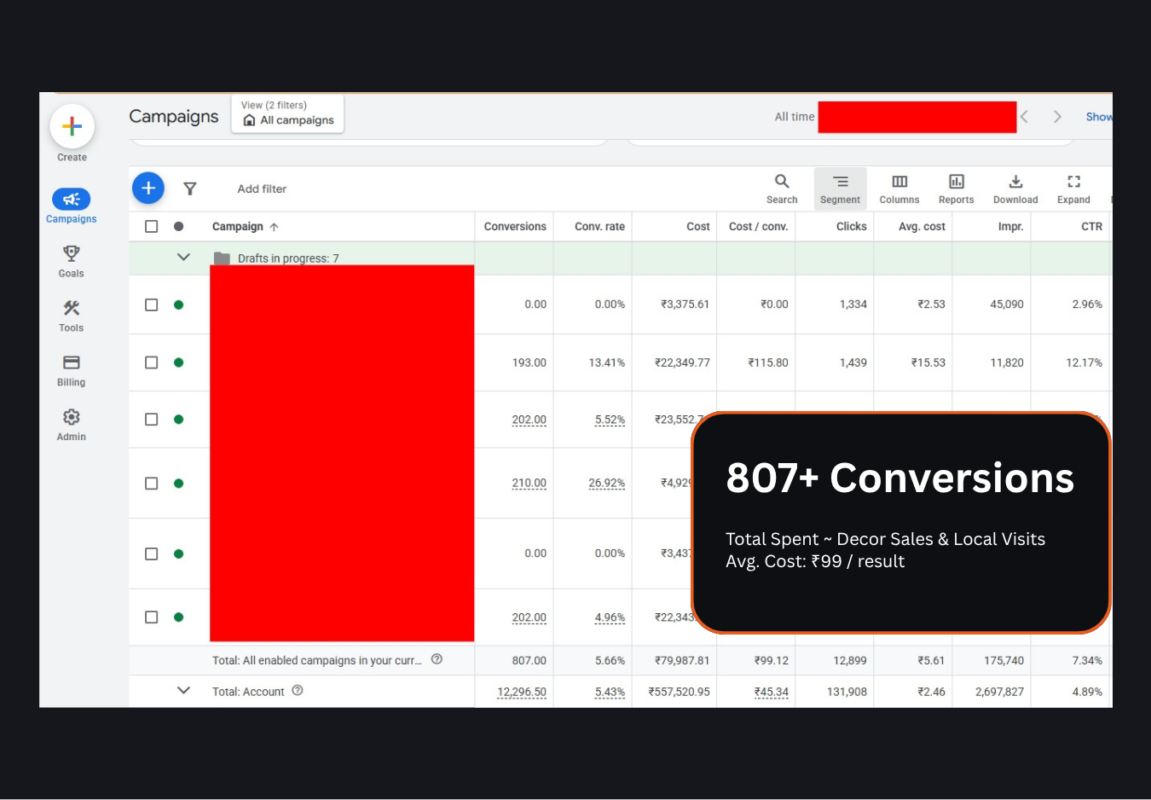
- Main outcome: Client reports ~₹1,25,000 in business sales on ~₹50,000 ad spend; dashboard shows 807 conversions at ₹99.12 each.
- Portfolio category: Google Ads / Local lead & sales generation.
Client Overview
This confidential Ahmedabad retailer sells furniture and home-decor products, from bedsheets and curtains to mattresses and wallpaper, through a physical showroom plus a recently launched website. The engagement focused on turning Google Ads into a measurable growth channel for both store footfall and online product sales.
The retailer operates a physical showroom in Ahmedabad and stocks everyday home-decor categories — bedsheets, curtains, mattresses, pillows and wallpaper — alongside furniture pieces. When the engagement began, the brand-new e-commerce website had almost no organic visibility, so paid campaigns had to carry the online side while local campaigns carried the footfall side.
The account is managed under a signed NDA, which is why this case study shares the industry, the city and the dashboard figures but withholds the business name. That agreement also shapes how we report everywhere: numbers travel, identities don’t.
The Problem / Challenge
The showroom needed steady, measurable local footfall while a brand-new website had to start selling products without any organic search history or review volume. Tight daily budgets, product-feed exclusions and previously unproven tracking meant every rupee of ad spend had to be defended.
- No measurable footfall system: store visits depended on walk-in traffic and word of mouth, with no campaign-level view of what actually drove buyers to the showroom.
- A website with zero sales history: no organic rankings, no review volume and no conversion data for smart bidding to learn from.
- Tight daily budgets: individual campaigns run between ₹100 and ₹350 per day, leaving almost no room for wasted spend or long learning phases.
- Feed and eligibility limits: the dashboard still flags some campaigns as limited by budget, missing relevant keywords, or with products excluded — constraints we plan around every single week.
Our Solution / Strategy
We split the account into three clearly job-defined campaign types: Local campaigns for footfall, Search campaigns for high-intent category queries, and Performance Max for website product sales. One shared conversion-tracking layer lets the client see exactly which rupee produced which result.
Discovery and local demand audit
We started offline, not online: store catchment, best-selling categories, price points and the questions buyers ask in person. Those answers became the keyword and category skeleton — curtains, mattresses, bedsheets, wallpaper and pillows — mirrored in the campaign structure so every product line could be measured on its own.
References: Google Business Profile · Google Ads Help
Campaign build: Local, Search and Performance Max
Each product line got its own campaign so budgets and bids could be tuned per category, and each campaign was assigned a single job: footfall, enquiry or online sale. Performance Max2 feeds the product catalogue into Shopping surfaces, while Local and Search campaigns keep the showroom visible for “near me” and category searches across Ahmedabad.
References: Google Ads · About Performance Max campaigns · Google Merchant Center
Tracking, QA and the weekly optimization rhythm
Every campaign reports into one conversion view, so the weekly review takes minutes, not hours. A quick Ctrl+F for limited by budget in the exported report shows exactly where a ₹50–₹100 daily raise is justified, and the fixed weekly rhythm below keeps the account honest.
Campaign naming convention (goal first, category second):
goal-category-DD/MM

Live examples from this account structure:
search-footfall-curtains-27/03
search-footfall-mattress-25/03
pmax-shopping-bedsheet-25/03
local-store-ahmedabad-core
Mon — budget pacing and bid review Wed — search-term mining plus negative keywords Fri — feed health and asset-group check Sat — store visit feedback matched to dashboard numbers
References: Google Ads Help · Google Ads API Developers
Tech Stack
The stack stays deliberately small and inexpensive to run: Google Ads Local, Search and Performance Max campaigns fed by a clean product feed and a verified business profile. Fewer tools mean faster learning loops, simpler reporting and lower monthly overhead for the client.
| Layer | Tool | Purpose | Official link |
|---|---|---|---|
| Footfall | Google Ads Local campaigns | Store visits, direction requests and calls from nearby buyers | ads.google.com |
| Intent | Google Search Ads | Category and “near me” queries with text ads | Google Ads Help |
| Online sales | Performance Max (Shopping) | Product listings across Search, Shopping and partner surfaces | Performance Max docs |
| Catalogue | Google Merchant Center | Product feed that powers Performance Max | merchants.google.com |
| Measurement | Google Ads conversion tracking | One shared view of cost, conversions and cost per conversion | Google Ads Help |
Execution / Process
Delivery followed a four-step loop: audit the store’s catchment and category demand, structure campaigns by product line, build tracking, then run a weekly optimization rhythm. Approvals happen over a short weekly call, so changes ship within days instead of weeks.
- Discovery and local demand audit — catchment, categories, price points, buyer questions.
- Account and feed setup — business profile link, Merchant Center feed, conversion tracking.
- Campaign build by product line — Local, Search and Performance Max with single-job budgets.
- Weekly QA and optimization — budget pacing, search-term mining, feed and asset health.
- Monthly client review — store sales feedback matched against unedited dashboard numbers.
Client Review / Project Quote
The client summarizes the engagement in one simple sentence: around ₹50,000 of ad spend is currently returning roughly ₹1,25,000 in business sales. Because the relationship is covered by a signed NDA, we publish the statement verbatim but withhold the retailer’s name and account identifiers.
We are spending around ₹50,000 and seeing about ₹1,25,000 in business sales. The store gets walk-ins from the ads and the website has started selling too.
Client statement — Ahmedabad furniture & home decor retailer (name withheld under NDA)
₹1,25,000 in reported sales against ~₹50,000 of ad spend: a 2.5x return, confirmed in the client’s own words and in Google’s own dashboard.
Swadeshi Sync Project Summary
Results / Metrics
Enabled campaigns in the dashboard snapshot show ₹79,987.81 total cost, 807 conversions and a blended cost per conversion of ₹99.12 across 12,899 clicks. The client independently reports about ₹1,25,000 in business sales against roughly ₹50,000 of recent spend — a 2.5x return.
| Campaign (category batch) | Cost (₹) | Conversions | Cost / conv. (₹) | Clicks | CTR |
|---|---|---|---|---|---|
| Bedsheet — 22/05 | 3,375.61 | 0.00 | 0.00 | 1,334 | 2.96% |
| Bedsheet — 25/03 | 22,349.77 | 193.00 | 115.80 | 1,439 | 12.17% |
| Curtains — 27/03 | 23,552.71 | 202.00 | 116.60 | 3,658 | 12.22% |
| Mattress — 25/03 | 4,929.26 | 210.00 | 23.47 | 780 | 9.66% |
| Pillows — 17/06 | 3,437.24 | 0.00 | 0.00 | 1,613 | 3.80% |
| Wallpaper — 26/03 | 22,343.22 | 202.00 | 110.61 | 4,075 | 10.61% |
| Total (enabled campaigns) | 79,987.81 | 807.00 | 99.12 | 12,899 | 7.34% |
- Best efficiency: the mattress campaign converts at ₹23.47 per conversion — the template we now copy into other categories.
- Footfall is now attributable: direction requests and store visits are tracked per campaign instead of guessed.
- The website is learning: every online conversion feeds product-level data back into smart bidding.
- Honest cleanup list: the 22/05 bedsheet and pillows campaigns are flagged for feed and budget fixes, not hidden.
Book a Call / Start a Similar Project
If you run a showroom, clinic or store in Ahmedabad and want the same footfall-plus-website playbook, we can map your catchment and categories in one call. The strategy call is free, and you leave with a budget plan even if we never work together.
Project FAQ
These answers cover the questions local retailers ask us most: scope, minimum budgets, tracking, confidentiality and how a similar engagement would run in their own account. Anything missing is just one message away through the contact buttons on this page.
What exactly did Swadeshi Sync run for this client?
Three campaign types inside one Google Ads account: Local campaigns for store footfall, Search campaigns for high-intent category keywords, and Performance Max for website product sales.
How much ad budget does the account use?
The account currently runs on a total budget of ₹1,550 per day, with individual campaigns set between ₹100 and ₹350 per day. Budgets are raised only after a campaign proves its cost per conversion.
Can one account really handle both footfall and online sales?
Yes. Local and Search campaigns optimize toward store visits and enquiries while Performance Max optimizes toward online purchases, and shared conversion tracking keeps both objectives measurable in one view.
The website was brand new. Did that delay results?
No. Paid campaigns generate click and conversion data from day one, so the website started collecting product-level demand signals while organic visibility matures in the background.
Will I see the real dashboard numbers if we work together?
Yes. Reporting uses unedited Google Ads dashboard views, including cost, conversions, cost per conversion, clicks, impressions and CTR, exactly as Google calculates them.
Why is the client name hidden?
The engagement is covered by a signed NDA. We share the industry, city and performance figures with permission, but never the business name or account identifiers.
Sources / Project References
- Google Ads — official platform page. ads.google.com ↩
- Google Ads Help — About Performance Max campaigns. support.google.com ↩
- Google Ads Help Center. support.google.com/google-ads
- Google Business Profile. business.google.com
- Google Merchant Center. merchants.google.com
Last updated: July 4, 2026.