
Facebook Lead Generation for Ahmedabad Real Estate Client that Scaled From ₹10,000 to ₹6,00,000 Monthly Ad Spend
A confidential Ahmedabad real estate builder went from a ₹10,000 monthly test Advertisement budget to ₹6,00,000 per month at peak, on the strength of one thing: Provide the leads that sales team could actually convert. This case study walks through how we (Swadeshi Sync) set up the client’s Facebook Ads account, layered high-intent Meta Ads campaigns on top, and built a stage-wise handoff process that made every salesperson’s job easier.1
Project Snapshot
- Client: Confidential (NDA-signed) — Ahmedabad-based real estate builder
- Industry: Real estate, residential flats and buildings
- Project type: Paid ads lead generation — Facebook Ads account setup plus Google Ads management
- Timeline: Long-term engagement; budget scaled from ₹10,000 to ₹6,00,000 per month at peak
- Core stack: Meta (Facebook) Ads, Google Ads, conversion and call tracking, stage-wise sales handoff
- Primary goal: Maximum volume of qualified leads for the client’s buildings and flats
- Main outcome: A steady flow of pre-qualified leads that needed less sales effort to convert, and a 60x budget scale driven by performance
Client Overview
This was an Ahmedabad-based residential real estate builder selling flats across multiple ongoing projects, protected here under NDA as a confidential client. The business wanted a predictable flow of genuine buyer leads instead of depending only on referrals, hoardings and site signage.
The builder was running several residential projects at the same time, each with its own inventory, pricing and target buyer. Word of mouth, channel partners and site hoardings brought inquiries, but volume swung month to month, and nobody could predict which project would get a trickle of calls and which would get a flood.
Leadership wanted marketing to behave like a tap, not like weather — open it, measure it, and scale it when it works. That single expectation shaped the entire engagement: every campaign had to produce measurable, callable leads, not just impressions.
The Problem / Challenge
Before the engagement, lead flow was unpredictable and the sales team spent hours chasing inquiries that never matched the right project, budget or location. There was no structured ad account, no clean conversion tracking, and no way to know which rupee of spend actually produced site visits.
- Inconsistent lead flow: inquiries depended on referrals and signage, so some months the sales team was idle and other months overwhelmed.
- No structured account: the ad account lacked a clean campaign architecture, so performance could not be traced to a project, audience or creative.
- Unqualified inquiries: callers with the wrong budget, wrong locality or wrong configuration consumed the same sales time as serious buyers.
- Blind budgeting: with no reliable cost-per-lead or cost-per-visit data, spending decisions were guesswork.
- Multiple projects, one message: different buildings with different inventory were being marketed with the same generic pitch.
The deeper issue was not just lead volume; it was lead fit. A caller asking for a 2 BHK in a project that only had 3 BHK inventory, or a budget far below the project’s price band, was a small tax on the sales team’s day — and multiplied across hundreds of calls, it quietly killed conversion rates.
Our Solution / Strategy
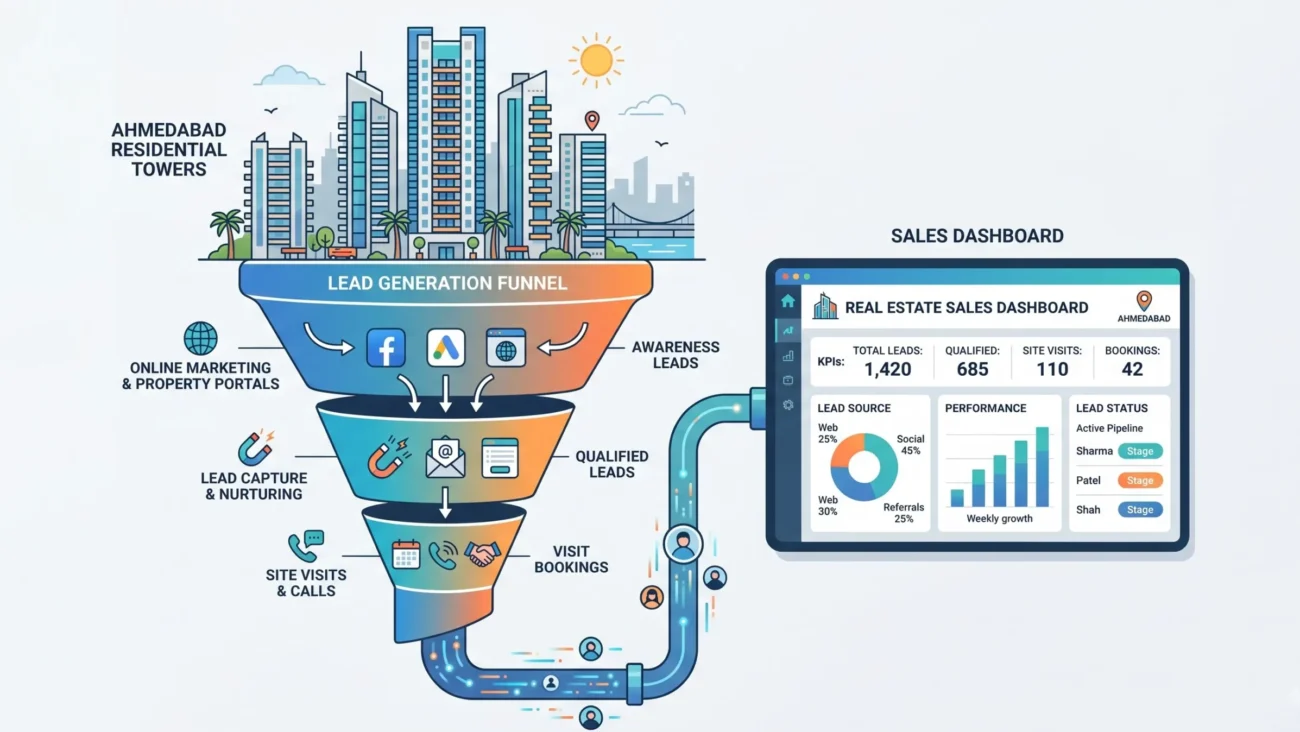
We built a two-platform lead engine: a properly structured Facebook Ads account for demand creation and Google Ads search, call and site-visit campaigns for high-intent buyers. Every lead was qualified at the form level and handed to the sales team through a clear stage-by-stage process.
Discovery and buyer-profile audit
We started by auditing how inquiries actually arrived and what happened to them afterwards. We mapped every project’s buyer profile — ticket size, locality, end-use versus investment — and interviewed the sales team about the questions that separate a serious buyer from a casual enquiry within the first two minutes of a call. That audit became the blueprint for campaign structure, lead-form questions and the shared definition of a qualified lead.
References: Meta Business Help Center · Google Ads Help
Facebook Ads account setup and lead campaigns
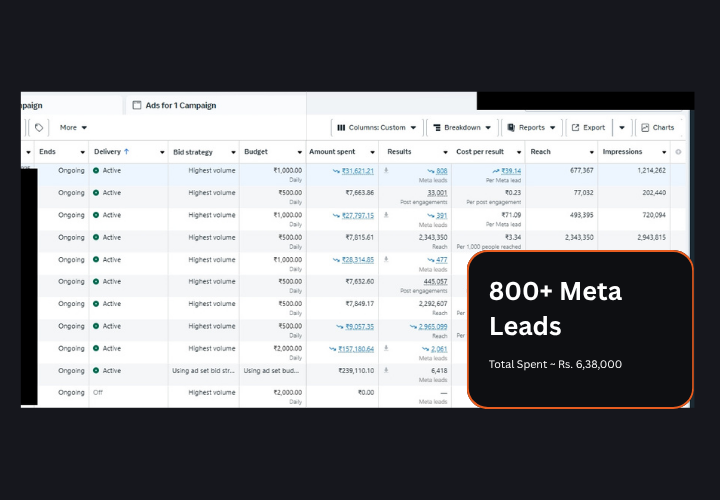
We set up the client’s Facebook Ads account properly from the ground up: business manager, page, pixel and lead tracking, then built project-wise lead campaigns with native lead forms that asked for budget range, preferred location and purchase timeline before a lead ever reached a salesperson. Creatives spoke the local language of the buyer — possession timelines, amenities, pricing hooks — and budgets followed one simple rule: scale only the ad sets that held their cost per qualified lead.1
References: Meta for Business — Ads · Meta Business Help Center
Google Ads search, call and site-visit campaigns
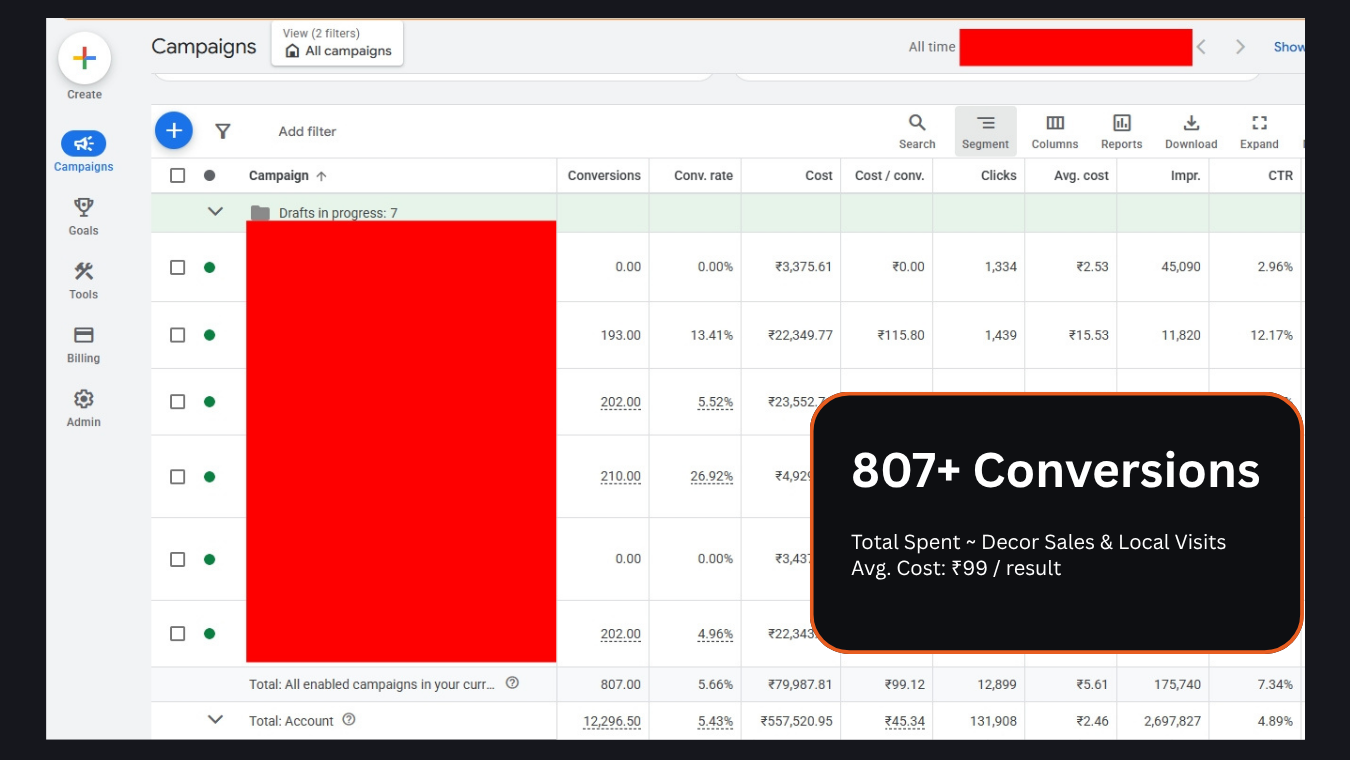
Alongside Facebook, we ran Google Ads for buyers who were already searching: area and configuration keywords for flats in Ahmedabad, call-only campaigns that pushed calls straight to the sales line, and site-visit campaigns optimised for the one action that matters most in real estate — a buyer physically standing at the site.2 The anonymised snapshot shows how hard these worked: the search-plus-call cluster and the call-only campaign together produced more than 800 conversions at a cost per conversion between ₹84 and ₹137, and the call campaign repeatedly went “limited by budget” — the healthiest complaint an account can have.
References: Google Ads · Google Ads Help
Lead quality and sales handoff
A lead is only as good as the follow-up it receives, so we formalised the journey every enquiry travels. Leads were tagged by project and routed to the right salesperson, who could open the tracker, hit Ctrl+F and see exactly which campaign, budget band and locality the buyer came from. The shift we cared about was simple: quality over raw volume, because one convertible lead is worth twenty cold ones.
Enquiry → Qualification → Follow-up → Site Visit → Negotiation → Booking
References: HubSpot · Salesforce
Campaign structure, tracking and QA
Every campaign followed a readable naming convention so any report could be understood at a glance, and every change went through a weekly QA pass: search terms reviewed, negatives added, budgets re-balanced, forms tested on real devices, and call tracking verified with test calls before a single rupee of scale went in.3
FB_[Project]_[Goal]_[Audience]_[DD-MM]
GA_[Project]_[Search|Call|Visit]_[Theme]_[DD-MM]

FB_Skyline_Leads_Lookalike2BHK_03-04
GA_NorthZone_CallOnly_RouteA_21-05
References: Google Ads Help — conversion and call tracking · Google Ads Developers
Tech Stack
The stack stayed lean on purpose: Meta Ads for creating demand among flat buyers, Google Ads for capturing search intent, and conversion plus call tracking to keep every rupee accountable. A simple stage-based handoff process connected marketing leads to the sales team without friction.
| Layer | Tool | Purpose | Official link |
|---|---|---|---|
| Paid social | Meta (Facebook) Ads | Account setup, project-wise lead campaigns, audience building | Meta for Business |
| Paid search | Google Ads | Search, call-only and site-visit campaigns per project | Google Ads |
| Tracking | Conversion and call tracking | Calls, forms and visits counted as measurable conversions | Google Ads Help |
| Handoff | Stage-wise sales process | Enquiry-to-booking pipeline shared with every salesperson | Salesforce |
Execution / Process
Delivery followed a strict order: audit first, then account setup, then campaign builds, then QA, and finally controlled scaling. The client only increased budget after each stage proved its cost per lead, which is why the account grew from ₹10,000 to ₹6,00,000 per month without gambling.
- Discovery and buyer-profile audit across all ongoing projects
- Facebook Ads account setup with pixel, lead forms and tracking
- Project-wise campaign builds on Facebook and Google Ads
- Lead qualification rules and stage-wise sales handoff design
- Weekly QA: search terms, negatives, budgets, forms and call tracking
- Performance-gated scaling with transparent reporting to leadership
Client Review / Project Quote
Because the engagement is covered by an NDA, we cannot publish a named testimonial, so this section uses a factual project statement instead. The strongest evidence remains the account itself: a test budget that grew sixty times because the leads kept justifying the spend.
The client continued the engagement and raised the monthly media budget from ₹10,000 to a peak of ₹6,00,000 — which is what businesses do only when leads keep paying for themselves.
Swadeshi Sync project record — client identity withheld under NDA
Sixty times the budget is not a marketing metric. It is a trust metric.
Swadeshi Sync
Results / Metrics
The account snapshot tells the story: 8,168 all-time conversions at an average cost of ₹98.07, with 250,990 clicks and a 4.39% click-through rate across more than 57 lakh impressions. More importantly, the sales team received pre-qualified leads that needed noticeably less effort to convert into site visits and bookings. The anonymised snapshot shown here covers the Google Ads side of the account structure; the Facebook Ads account we set up ran in parallel with the same stage-wise discipline.
| Metric | Before | After | Impact |
|---|---|---|---|
| Monthly ad budget | ₹10,000 test spend | ₹6,00,000 at peak | 60x scale, unlocked only by proven performance |
| Lead flow | Unpredictable referrals and signage | Daily qualified inquiries | A pipeline the sales team could plan around |
| Sales effort | Cold chasing of mismatched inquiries | Pre-qualified, project-matched leads | Faster follow-ups and less wasted call time |
| Cost visibility | No cost-per-lead data | Tracked Cost/conv. as low as ₹84.22 | Budget decisions made from data, not guesswork |
| Metric (account snapshot) | Value | Why it matters |
|---|---|---|
| Impressions, all time | 5,716,368 | Strong visibility across project keywords and audiences |
| Clicks | 250,990 | Steady traffic at sensible average costs |
| CTR | 4.39% | Ads matched real buyer intent |
| Conversions | 8,168 | Calls, forms and visits captured as trackable leads |
| Avg. cost per conversion | ₹98.07 | Lead costs that made scaling rational |
| Best campaign cost/conv. | ₹84.22 at 16.87% conv. rate | Search plus call-goal campaigns did the heavy lifting |
Book a Call / Start a Similar Project
If you are a builder or developer struggling with inconsistent inquiries, this same playbook can be rebuilt for your projects, cities and budgets. Start with a free strategy call and we will map your lead flow, tracking and sales handoff before you spend a rupee.
Project FAQ
These answers cover the questions we are asked about almost every paid lead generation project: scope, confidentiality, budget sizing, lead quality, conversion tracking and sales handover. If your question is not covered here, it probably belongs in a free strategy call where we can discuss your specific projects and market.
What type of project is this?
A paid media lead generation engagement for a residential real estate builder: Facebook Ads account setup, Google Ads campaign management and a stage-wise sales handoff process.
Why is the client’s name not published?
We signed a non-disclosure agreement with this client, so all identifiers are withheld. The performance snapshot is shared only in anonymised form, with the client’s permission.
How did the budget grow from ₹10,000 to ₹6,00,000 per month?
Scaling was performance-gated. The client started with a small test budget, and each time cost per lead and lead quality held steady, the budget was stepped up — until it peaked at ₹6,00,000 per month.
What counted as a lead or conversion in the account?
Depending on the campaign, conversions included phone calls, lead-form submissions and site-visit actions, all measured with conversion and call tracking so every rupee had a result attached.
How did you make sure leads needed less sales effort?
Lead forms asked qualifying questions about budget, location and purchase timeline, so the sales team mostly spoke to buyers who already matched the project profile instead of chasing mismatched inquiries.
Will this work for builders in other cities?
Yes. The structure — project-wise campaigns, call goals, qualified lead forms and stage-wise handoff — is city-agnostic. Only the audiences, creatives and budgets change with the market.
Who owns the ad accounts and the data?
The client. Accounts were set up under the client’s own business manager and billing, so all data, audiences and campaign history remain the client’s property.
Sources / Project References
- Meta for Business — Ads. https://www.facebook.com/business/ads ↩
- Google Ads. https://ads.google.com ↩
- Google Ads Help — conversion and call tracking. https://support.google.com/googleads ↩
- Meta Business Help Center. https://www.facebook.com/business/help
- CREDAI — Confederation of Real Estate Developers’ Associations of India. https://www.credai.org
Last updated: August 24, 2026.