

AI News 13th to 18th September 2026: Navier-Stokes, YuE2 & DeepSeek V4.1
The 13 to 18th September 2026 window is the week AI closed a Millennium Prize ticket: OpenAI published an AI-generated finite-time blowup construction for the Navier–Stokes existence-and-smoothness problem, complete with a Lean formal proof,1 while DeepSeek open-sourced the 552B-parameter multimodal MoE V4.1 Flash under MIT, edge0 squeezed a 35B MoE into 3 GB of RAM, YuE2 turned laptops into wedding-band composers, and Google DeepMind freed a one-petabyte atlas of all nine billion possible human DNA letter changes. Five days, sixteen verified releases, one very warm bookmark folder. Our bookmark folder now needs its own bookmark folder.
Key Takeaways
- Millennium math: OpenAI’s 8 September Navier–Stokes blowup construction ships with a writeup and a Lean certificate; community verification, including discussion on Terence Tao’s blog, was still running at press time.
- Biggest open MoE: DeepSeek V4.1 Flash — 552B backbone, 8B active on input and 16B on output, 1M-token context, FP4 KV cache, MIT weights on Hugging Face.2
- Smallest big model: edge0 streams Edge0-35B-A3B from SSD in under 3 GiB of active memory at roughly 15 tokens per second on Apple Silicon.
- Local music frontier: YuE2-3B generates full songs with vocals plus an editable ABC-notation score, open-weight, with ComfyUI workflows already live.
- One speech model to rule them: Tencent’s 1.5B AuK unifies zero-shot TTS, instruction editing, enhancement and separation behind a single natural-language interface.
- Genomics at atlas scale: AlphaGenome Atlas predicts the molecular effect of every possible single-letter change in the human genome — about nine billion variants — free, at roughly one petabyte.3
- Worlds without waitlists: LingBot-World 2.0 streams interactive 720p60 worlds for up to an hour from open 14B and 1.3B checkpoints.
- Robot stack of the week: Isaac 0.5 (36B open MoE), Show-Harness (VLM agents zero-shot “playing” robots), UniMate + UMR (retargeting without per-rig work) and Unitree’s 6B UnifoLM-WLA-1.0.
In This Roundup
- Maths & Frontier — Navier–Stokes blowup, DeepSeek V4.1 Flash, ChatGPT for Financial Services
- Worlds & 3D — LingBot-World 2.0, WorldSculpt, FIRE3D, Marigold V2
- Audio & Creative — YuE2 vs Suno v6, Tencent AuK
- Robotics & Embodiment — Isaac 0.5, Show-Harness, UniMate + UMR, UnifoLM-WLA
- Local Infra — edge0 streaming MoE, MiniCPM5-2B
- Science Corner — AlphaGenome Atlas maps nine billion DNA variants
- FAQ
- Final Verdict — what to run this weekend
Maths & Frontier — Navier–Stokes blowup, DeepSeek V4.1 Flash, ChatGPT for Financial Services
Three frontier stories defined 13 to 18th September 2026: OpenAI’s AI-generated blowup construction for the Navier–Stokes Millennium Prize problem with a Lean formal proof, DeepSeek’s MIT-licensed V4.1 Flash multimodal MoE with 552 billion backbone parameters and 8 billion active, and OpenAI’s ChatGPT for Financial Services built on GPT-6 Astra with Morgan Stanley. All three ship with public artifacts reviewers can inspect today.
One does not simply “skim” this week’s AI news. You blink, and a 200-year-old math problem has a Lean certificate.
OpenAI vs Navier–Stokes — a Millennium Prize ticket, closed by AI?
OpenAI published an AI-generated solution to the Navier–Stokes Millennium Prize problem on 8 September 2026: a finite-time blowup construction showing the equations can develop singularities, accompanied by a written exposition and a formal proof in Lean. Quanta framed it as the first of the seven $1-million Millennium Prize problems to fall to an AI system, and the release includes a public repository with the proof artifacts.
The honest caveats matter: mathematicians were still auditing the construction during this window, Terence Tao’s blog hosted a related independent Euler-blowup result the same week, and the Clay Mathematics Institute’s prize requires formal acceptance of any proof. Read it as the strongest AI-assisted mathematics result ever published, not yet as settled history. (Clay: “we’ll be in touch about the million.” OpenAI: “no rush.”)
References: OpenAI results page · Quanta Magazine report · Proof repository (GitHub)
DeepSeek V4.1 Flash — 552B MoE, 8B active, MIT licence
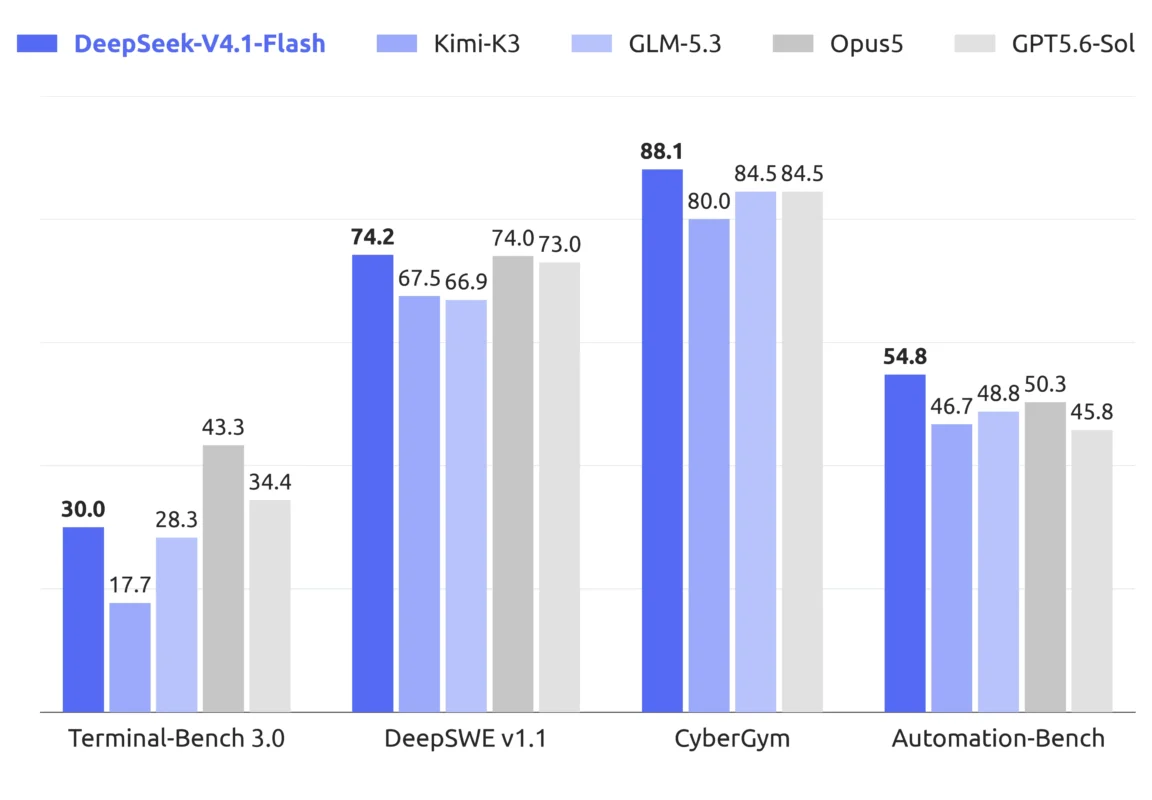
DeepSeek V4.1 Flash went live on the DeepSeek API on 10 September 2026 and landed on Hugging Face under an MIT licence days later: a multimodal Mixture-of-Experts with a 552B-parameter backbone, only 8B active parameters on input and 16B on output, a 1-million-token context window and an FP4 KV cache, built on a new asymmetric Causal-Encoder-Decoder design.2 Promo API pricing started 04:00 UTC on 14 September, squarely inside this window.
The strategic pattern is now unmistakable: DeepSeek ships API-first, open-weights second, and lets the community host the thing forever. For Indian startups billing per token, an 8B-active multimodal MoE with 1M context is the kind of price-performance event that resets procurement spreadsheets.
References: DeepSeek launch post · Model card and weights (Hugging Face) · API documentation note
ChatGPT for Financial Services — OpenAI courts Dalal Street too
OpenAI introduced ChatGPT for Financial Services on 10 September 2026, a specialised ChatGPT Work edition combining built-in financial data with GPT-6 Astra for research, modelling and client-ready materials. Coverage notes it was developed with Morgan Stanley and explicitly targets the labour-intensive research, modelling and pitchbook work of junior bankers and equity analysts.
Whether it replaces analysts or merely replaces their weekends remains an open question, but the verticalisation signal is clear: frontier labs now ship industry-packaged agents, not just models.
References: OpenAI announcement · Fortune launch report · CNBC analysis
| Release | Parameters | Runs on | Licence | Standout stat |
|---|---|---|---|---|
| DeepSeek V4.1 Flash | 552B MoE (8B/16B active) | API + multi-GPU host | MIT | 1M-token context, FP4 KV cache |
| Edge0-35B-A3B | 35B MoE (3B active) | Apple Silicon, 3 GiB RAM | Open source | ~15 tok/s streamed from SSD |
| MiniCPM5-2B | 2.6B dense | Phones, laptops | Apache 2.0 | Native vLLM support |
| YuE2-3B | 3B | Consumer GPU | Open weights | Songs + editable ABC scores |
| AuK | 1.5B | Consumer GPU | Open weights | Speech gen + edit in one interface |
| LingBot-World 2.0 | 14B + 1.3B | Single GPU (1.3B) | Open weights | 720p60 worlds up to one hour |
Local AI in September 2026: a 35B model in 3 GB of RAM, a frontier song in 3B parameters, a robot controller in a LoRA. The cloud is filing a complaint.
Swadeshi Sync desk, 18 September 2026
Worlds & 3D — LingBot-World 2.0, WorldSculpt, FIRE3D, Marigold V2
Four vision releases make 3D practical this window: LingBot-World 2.0 streams interactive 720p60 worlds for up to an hour, WorldSculpt turns grounded videos into compositional scenes of hundreds of editable meshes, FIRE3D reconstructs simulation-ready 3D assets from one casual video in under a minute, and Marigold V2 turns a diffusion transformer into a single-step depth estimator. Every one of them ships code, weights or both.
LingBot-World 2.0 — hour-long interactive worlds at 60 FPS
LingBot-World 2.0 (Infinity) from Robbyant generates open-ended interactive worlds that stay visually coherent over long horizons while running in real time at 720p and 60 FPS, with sessions lasting up to an hour and multi-user interaction. The release pairs a primary 14B causal-fast checkpoint with a 1.3B companion that deploys on a single consumer GPU, and weights are open on Hugging Face and ModelScope.
References: Official tech page · Code (GitHub) · 14B causal-fast weights (ModelScope)
WorldSculpt — hundreds of objects, each its own mesh
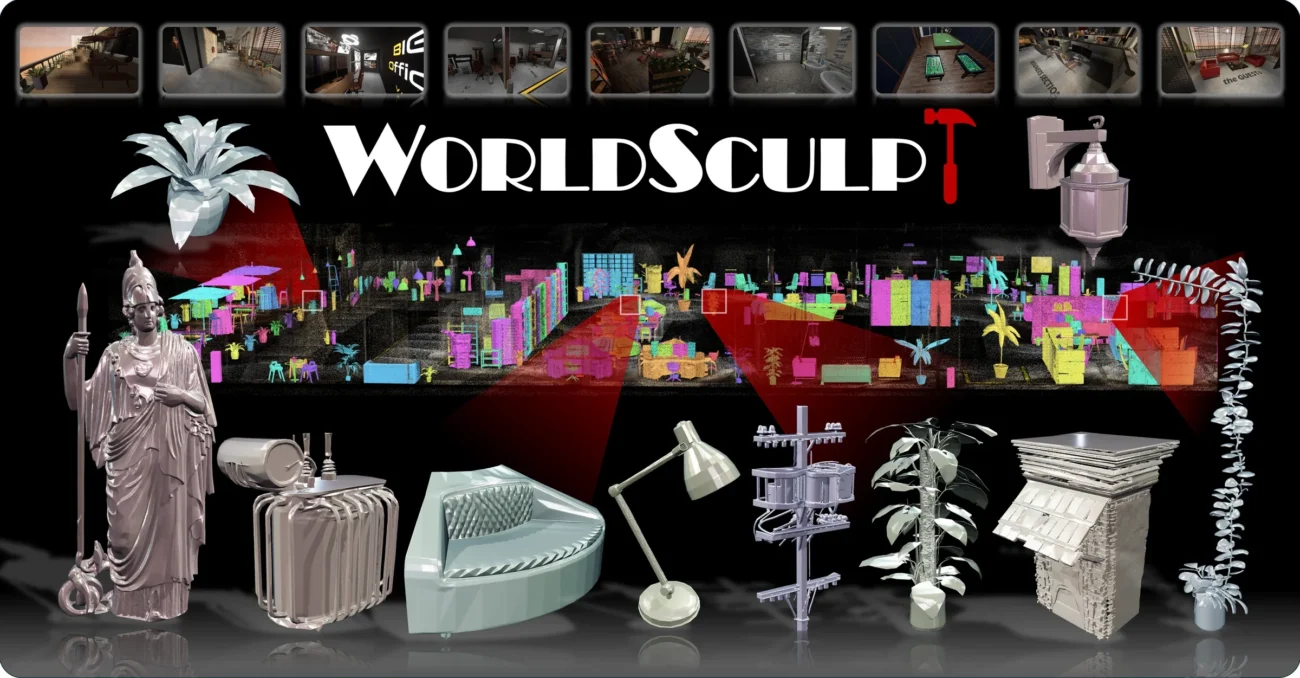
WorldSculpt (arXiv 2609.05416) generates compositional 3D representations of cluttered real scenes from grounded videos: hundreds of objects, each reconstructed as an individual, individually placed mesh rather than one fused blob. The team released code, weights and the UE-MeshyScene benchmark of 2,299 scenes, making it the first compositional world generator you can actually audit end to end.
References: Project page · Paper (arXiv 2609.05416) · Code and weights (GitHub)
FIRE3D — simulation-ready 3D scenes in under a minute
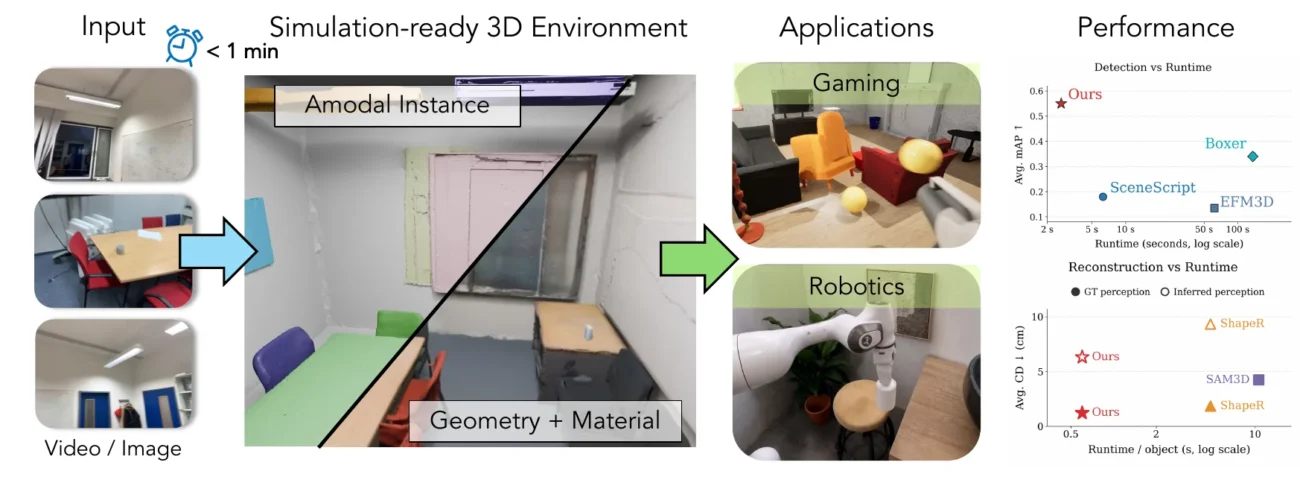
FIRE3D, from UIUC and Cornell (arXiv 2609.08848), takes a single RGB image or casual RGB video and produces simulation-ready, object-compositional 3D scene assets in under a minute: a feed-forward network predicts 6-DoF object poses, shapes and textured materials from posed RGB-D estimates, with no test-time optimisation loop. Code, models and inference data are public.
References: Project page · Paper (arXiv 2609.08848) · Code (GitHub)
Marigold V2 — a diffusion transformer that sees depth in one step
Marigold V2 (Huawei Bayer Lab, SIGGRAPH Asia 2026) repurposes a pretrained image-editing diffusion transformer (Qwen-Image Edit 2509) into a single-step monocular estimator for depth, surface normals and albedo, using LoRA, iREPA, SinkLoss and decoder tuning to keep object boundaries razor sharp. It holds state-of-the-art depth results on standard benchmarks, and ComfyUI tutorials already cover depth, normal and albedo passes.
from transformers import pipeline
pipe = pipeline("depth-estimation", model="huawei-bayerlab/marigold-v2-0")
out = pipe("living-room.jpg")
out["depth"].save("living-room-depth.png")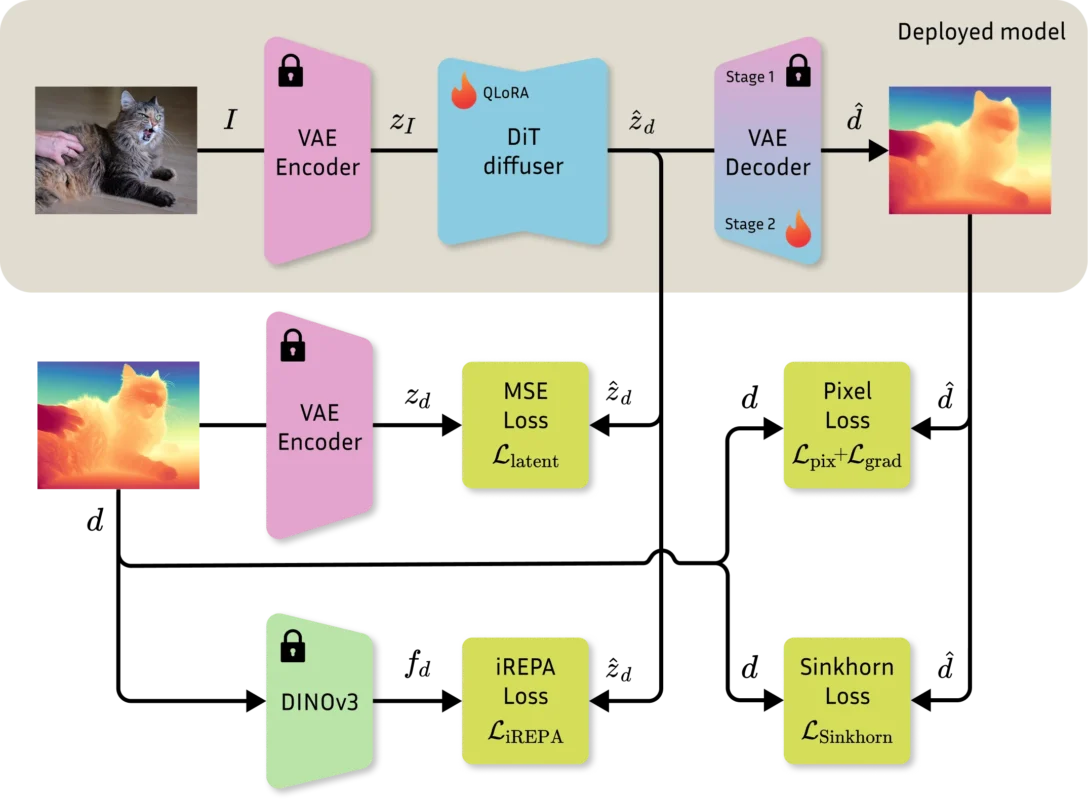
References: Weights (Hugging Face) · Code (GitHub) · Paper (arXiv 2609.08084)
Audio & Creative — YuE2 vs Suno v6, Tencent AuK
Two open audio models and one licensed giant collided this week: YuE2-3B generates frontier-quality songs locally with editable symbolic scores, Tencent’s 1.5B AuK unifies speech generation, editing, enhancement and separation behind one natural-language interface, and Suno shipped v6 on 9 September 2026 with Warner Music Group, BMG and Believe as partners. Local and licensed creation now race on one timeline.
Suno who? This week your laptop learned to compose the sangeet set, and it takes requests in ABC notation.
YuE2 — frontier songs with sheet music attached
YuE2 unifies symbolic and audio music generation at frontier quality: a 3B open model first plans melody and chords as symbolic music in ABC notation, then renders full vocal and instrumental arrangements in sound. Because the score is explicit, outputs are editable like a project file, not just re-rollable waveforms. Weights live on Hugging Face (m-a-p/YuE2-3B), Comfy-Org publishes workflow support, and reviewers consistently compare song quality to paid Suno tiers. Queue batches with Ctrl+Enter in ComfyUI and let the family laptop moonlight as a music director.
References: Code and demos (GitHub) · YuE2-3B weights (Hugging Face) · Demo page
Suno v6 — the licensed counterattack
Suno introduced v6 on 9 September 2026, a new generation of music models developed with industry partners including Warner Music Group, BMG and Believe, replacing every previous model in the lineup. Coverage of the release describes three variants plus input modes that turn photos, videos and voice memos into finished songs — the licensed, label-safe answer to the open-weights wave YuE2 is riding.
References: Suno official launch post · v6 / v6-wild / v6-mini explainer
AuK — one 1.5B model for every speech task
AuK from Tencent Hunyuan (arXiv 2609.08936) is a 1.5B open-weights foundation model that unifies speech generation and editing through one interface of natural-language instructions plus reference audio: zero-shot TTS, word-level content replacement, acoustic editing, enhancement and separation, trained on millions of hours of audio. Tencent’s own launch post called it “Nano banana for audio”, and the comparison is fair — one prompt in, edited audio out.
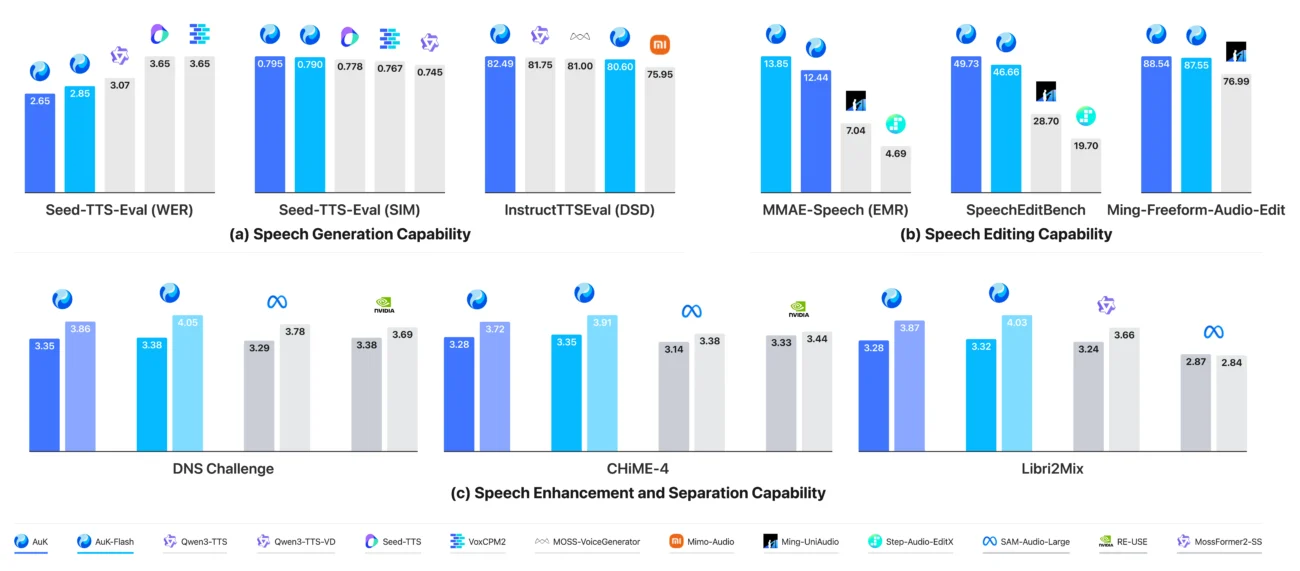
AuK is officially here. Nano banana for audio. An open-source foundation model for unified speech generation and editing. Natural-language instructions + reference audio. One interface.
Tencent Hunyuan, launch post on X
References: Code (GitHub) · Weights (Hugging Face) · Technical report (arXiv)
Robotics & Embodiment — Isaac 0.5, Show-Harness, UniMate + UMR, UnifoLM-WLA
Four embodied releases tighten the human-to-robot pipeline: Perceptron’s Isaac 0.5 opens a 36B dynamic-MoE embodied foundation model, Show-Harness lets ordinary VLM agents zero-shot “play” robots through semantic action tokens, UniMate and UMR remove per-skeleton and per-robot retargeting work, and Unitree’s 6B UnifoLM-WLA-1.0 handles tabletop plus whole-body manipulation in one open model. The bottleneck is shifting from data collection to interface design.
Isaac 0.5 — a 36B open embodied foundation model
Isaac 0.5 from Perceptron AI is a 36-billion-parameter dynamic-MoE open-weight embodied foundation model combining multimodal video understanding, embodied reasoning and direct robot control; the team describes it as the first open model at its scale for embodied tasks. Weights and a technical PDF are public, and the model reads images, video and language before acting.
| Model | Robot training scope | Obs. steps | RTC-trained | Prev. actions | Mistake modeling | Non-robot video | Flow expert | Open source |
|---|---|---|---|---|---|---|---|---|
| Isaac 0.5 | 35 embodiments | 1–3 | Yes | Yes | Yes | Yes | Yes | Yes |
| π0.5 | ~7 robots | 1 | No | No | No | Yes | Yes | Yes |
| Qwen-VLA | ~10 robots | 1+ | No | No | No | Yes | Yes | No |
| LingBot-VLA | 9 robots | 1 | No | No | No | No | Yes | Yes |
| MolmoAct2 | ~5 embodiments | 1 | No | No | No | Yes | Yes | Yes |
| SmolVLA | 1 embodiment | 1 | No | No | No | No | Yes | Yes |
| Octo | 25 datasets | 2 | No | No | No | No | No | Yes |
| OpenVLA | Not reported | 1 | No | No | No | No | No | Yes |
References: Launch post · Weights (Hugging Face) · Code (GitHub)
Show-Harness — any VLM can now play a robot
Show-Harness (ShowLab, NUS; arXiv 2609.10522) is an embodied harness that lets vision-language models “play” robots through a compact semantic interface: two camera views in, one semantic action token out, with embodiment-specific interpreters translating intent into joint commands. Released LoRA adapters turn off-the-shelf VLMs into zero-shot robot controllers — the MEA-loop lesson from August generalising to hardware.
References: Project page · Paper (arXiv 2609.10522) · VLM LoRA adapters (Hugging Face)
UniMate + UMR — retargeting without the per-rig tax
UniMate (arXiv 2609.05415) is a topology-aware diffusion transformer that animates arbitrary skeletons — bipedal, quadrupedal, exotic rigs — from a rigged 3D asset plus a text prompt, in real time, with no per-skeleton retraining, trained on the 13,006-sequence UniML3D corpus. Paired conceptually with UMR (arXiv 2609.02134), which retargets human motion to humanoids via learned dense point-cloud correspondence instead of hand-built keypoint maps, the week’s message is simple: stop re-engineering motion for every new body.

References: UniMate paper (arXiv) · UMR code (GitHub) · UMR paper (arXiv)
UnifoLM-WLA-1.0 — Unitree’s one-model whole-body worker
UnifoLM-WLA-1.0 is Unitree’s 6B humanoid foundation model trained on roughly 2,500 hours of real-robot data and evaluated across 64 tasks: a single model coordinates tabletop manipulation and whole-body mobile manipulation, generalising across tasks and end-effectors. Weights and tooling sit in Unitree’s open-source model collection.
References: Model page · Code (GitHub) · Weights collection (Hugging Face)
Local Infra — edge0 streaming MoE, MiniCPM5-2B
Two releases shrink where big models live: edge0 streams a 35B-parameter MoE from SSD in under 3 GiB of active memory using expert offload, Recover-LoRA and a trained prerouter, while OpenBMB’s Apache-2.0 MiniCPM5-2B puts a 2.6B dense reasoner on phones and laptops with native vLLM support. Together they make “run it locally” the default answer for September 2026.
When RAM says “budget exceeded”, jugaad says “stream the experts from SSD”. edge0 clearly read every Indian developer’s diary.
edge0 — 35B MoE in 3 GB, straight from your SSD
edge0 is an open-source streaming MoE inference framework that generalises a production recipe: SSD expert offload (frozen int4 expert pool on NVMe), Recover-LoRA (distilled adapters that pay back quantisation loss) and a prerouter head that predicts the next layer’s routing one step ahead so expert fetches never stall the pipeline. The Edge0-35B-A3B preview runs a 35B model in under 3 GiB of active memory at about 15 tokens per second on Apple Silicon, with the method paper at arXiv 2609.18063.
  EDGE0 STREAMING MoE (35B-A3B)
  ────────────────────────────────────────────
  GPU HBM      : top-k hot experts, 3B active
  SSD NVMe     : frozen int4 expert pool (offload)
  Recover-LoRA : repays int4 quantization loss
  prerouter    : predicts next-layer routing 1 step ahead
  result       : <3 GiB RAM, ~15 tok/s on Apple Silicon
References: Framework (GitHub) · Paper: Serving 35B MoEs from SSD (arXiv 2609.18063) · Model preview (Hugging Face)
MiniCPM5-2B — SOTA reasoning in pocket size
MiniCPM5-2B from OpenBMB is a dense 2B-class transformer (2.6B by independent counting) released under Apache 2.0, built for on-device and resource-constrained deployment with paired deployment and fine-tuning agent skills. vLLM supports it natively from v0.21.0, which makes it the cheapest sane default for offline assistants, edge routers and that old laptop in your cupboard.
References: Model card (Hugging Face) · Code (GitHub) · Artificial Analysis release note
Science Corner — AlphaGenome Atlas maps nine billion DNA variants
Google DeepMind’s AlphaGenome Atlas, released 8 September 2026, is a free roughly one-petabyte database predicting the molecular effect of every possible single-letter change in the human genome — about nine billion variants — at single-letter resolution. It turns rare-disease variant interpretation from a months-long literature hunt into a searchable lookup for researchers and clinicians.
Google DeepMind read all three billion letters of your DNA so your curiosity gets an atlas, not a “please consult your physician” popup.
AlphaGenome Atlas — every possible typo in your genome, indexed
The Atlas extends DeepMind’s AlphaGenome model (which reads up to one million DNA letters at single-letter resolution) into a precomputed, searchable database covering all ~9 billion possible single-nucleotide variants in the human genome, freely accessible at roughly one petabyte.3 Sundar Pichai and Demis Hassabis both framed it as infrastructure for rare-disease diagnosis and functional genomics, and coverage highlights its use for interpreting variants of unknown significance.
We’re introducing AlphaGenome Atlas, a database predicting the effects of every possible single nucleotide variant in the human genome.
Google DeepMind, AlphaGenome Atlas announcement
References: Google announcement · DeepMind science blog · Times of India coverage
Adopt now
- edge0 for serving any MoE on memory-starved hardware
- Marigold V2 depth/normal passes in ComfyUI scene pipelines
- YuE2-3B for open, editable music generation
- AuK for instruction-driven speech editing tooling
- Show-Harness LoRAs for zero-shot VLM robot control experiments
- AlphaGenome Atlas lookups in variant-triage research workflows
Watch and wait
- Navier–Stokes construction until peer verification and Clay review conclude
- DeepSeek V4.1 Flash pricing after the promotional window closes
- Suno v6 licensing terms for commercial and cover usage
- LingBot-World 2.0 multi-user sessions beyond demo length
- UnifoLM-WLA-1.0 beyond its published 64-task suite
AI Roundup 13 to 18th September 2026 FAQ
The most common questions about the 13 to 18th September 2026 window concern whether OpenAI truly solved a Millennium Prize problem, which new models are genuinely open-weight, whether local music and speech generation now match paid tools, and how edge0 runs a 35B model in 3 GB. Short version: the Navier–Stokes construction is published with a Lean proof but still under verification, DeepSeek V4.1 Flash and YuE2-3B are open today, and edge0’s SSD streaming is real and reproducible.
Did OpenAI really solve the Navier–Stokes Millennium Prize problem?
OpenAI published an AI-generated blowup construction for the Navier–Stokes existence-and-smoothness problem on 8 September 2026, with a writeup and a Lean formal proof, and Quanta reported it as the first Millennium Prize problem solved by AI. Community verification, including discussion on Terence Tao’s blog, was still ongoing at press time, and the $1 million Clay prize requires formal acceptance.
Is DeepSeek V4.1 Flash open weights?
Yes. The 552B-parameter multimodal MoE with 8B active input parameters and 16B active output parameters, 1M-token context and FP4 KV cache is on Hugging Face under an MIT licence, and it has been live on the DeepSeek API since 10 September 2026 with promo pricing from 14 September.
Can YuE2 really replace Suno on a local machine?
YuE2-3B generates complete songs with vocals plus an editable symbolic score in ABC notation at quality reviewers compare to paid Suno tiers, and weights are open on Hugging Face. Suno v6, shipped 9 September 2026 with Warner Music Group, BMG and Believe partnerships, remains the licensed commercial option while YuE2 is the open local one.
What is edge0’s SSD expert offload?
edge0 streams mixture-of-experts weights from NVMe SSD instead of holding them in RAM, freezes the int4 base, restores quantization loss with a distilled Recover-LoRA, and uses a prerouter head that predicts next-layer routing one step ahead. The Edge0-35B-A3B preview runs a 35B MoE in under 3 GiB of active memory at about 15 tokens per second on Apple Silicon.
What does AlphaGenome Atlas contain?
AlphaGenome Atlas is a free, roughly one-petabyte Google DeepMind database released 8 September 2026 that predicts the molecular effect of every possible single-letter change in the human genome, about nine billion variants, at single-letter resolution, aimed at rare-disease interpretation and research.
Is LingBot-World 2.0 open source?
Yes. Robbyant released LingBot-World 2.0 (Infinity) with a 14B causal-fast checkpoint and a 1.3B single-GPU variant on Hugging Face and ModelScope; it streams interactive 720p worlds at 60 FPS for up to an hour with multi-user control.
What can FIRE3D reconstruct in under a minute?
FIRE3D turns a single RGB image or casual RGB video into simulation-ready, object-compositional 3D scene assets with 6-DoF poses and textured meshes in under a minute using a feed-forward network, with code and weights released by the UIUC and Cornell team.
Which open speech model unifies generation and editing?
Tencent Hunyuan’s AuK is a 1.5B open-weights foundation model that handles zero-shot TTS, instruction-based content and acoustic editing, enhancement and separation through one natural-language interface, with weights on Hugging Face and ModelScope.
Final Verdict — What to Run This Weekend
If you run three things from 13-18 September 2026, run edge0 on your heaviest MoE, run YuE2-3B for your next demo jingle, and run Marigold V2 on one ordinary photo to feel single-step depth quality. The structural lesson: memory walls and licence walls are falling at the same time, and open artifacts now ship the same week as the headline result.
The Navier–Stokes construction is the fortnight’s biggest claim and its biggest open question — a Lean certificate is a strong invitation, not a verdict, and the verification thread is the most valuable reading in mathematics this month. Meanwhile the practical column keeps compounding: 35B models in 3 GB, frontier songs in 3B, speech editing in 1.5B, hour-long worlds in 1.3B. For Indian builders on rupee budgets, that column is the entire strategy document.
Watch-list for the next roundup: Clay Institute’s response to the blowup construction, DeepSeek V4.1 Flash pricing after the promo window, Suno v6’s licensing fine print, and whether Show-Harness-style semantic interfaces become the default VLM-to-robot bridge. If even two of those land, the last week of September will out-publish the first.
Sources and Further Reading
- OpenAI, “On the Navier–Stokes Millennium Prize Problem”, 8 September 2026; and Quanta Magazine, “AI Has Solved One of Math’s $1 Million Millennium Prize Problems”. ↩
- DeepSeek, “Introducing DeepSeek-V4.1-Flash”, 10 September 2026; model card on Hugging Face. ↩
- Google DeepMind, “AlphaGenome Atlas: a high-resolution map of human DNA”, 8 September 2026; and the DeepMind science blog. ↩
- OpenAI, “Introducing ChatGPT for Financial Services”, 10 September 2026; Fortune, launch report.
- OpenBMB, MiniCPM5-2B model card, Apache 2.0; code (GitHub).
- Robbyant, LingBot-World 2.0 tech page; code (GitHub); arXiv 2607.07534.
- Alaya Lab, WorldSculpt project page; paper (arXiv 2609.05416); dataset (Hugging Face).
- Xia et al., FIRE3D project page; paper (arXiv 2609.08848); code (GitHub).
- Huawei Bayer Lab, Marigold V2 demo space; paper (arXiv 2609.08084); SIGGRAPH Asia 2026.
- Multimodal Art Projection, YuE2 code and demos (GitHub); YuE2-3B weights (Hugging Face).
- Suno, “Introducing v6”, 9 September 2026; v6 variant explainer.
- Tencent Hunyuan, AuK code (GitHub); technical report (arXiv 2609.08936); weights (Hugging Face).
- Edge0 AI, edge0 framework (GitHub); “Serving 35B MoEs from SSD with Trained Routing Prediction” (arXiv 2609.18063).
- ShowLab (NUS), Show-Harness project page; paper (arXiv 2609.10522); code (GitHub).
- Perceptron AI, “Introducing Isaac 0.5”; weights (Hugging Face).
- Mou et al., UniMate project page; paper (arXiv 2609.05415).
- UMR authors, UMR project page; paper (arXiv 2609.02134); code (GitHub).
- Unitree, UnifoLM-WLA-1.0 model page; weights collection (Hugging Face).
Last updated: 18 September 2026. All releases verified against official vendor pages, public GitHub/Hugging Face repositories, arXiv papers and reputable coverage. The Navier–Stokes result is reported as claimed by OpenAI and remains under community verification; pricing, availability and licence terms change fast — verify on the source pages before production decisions.